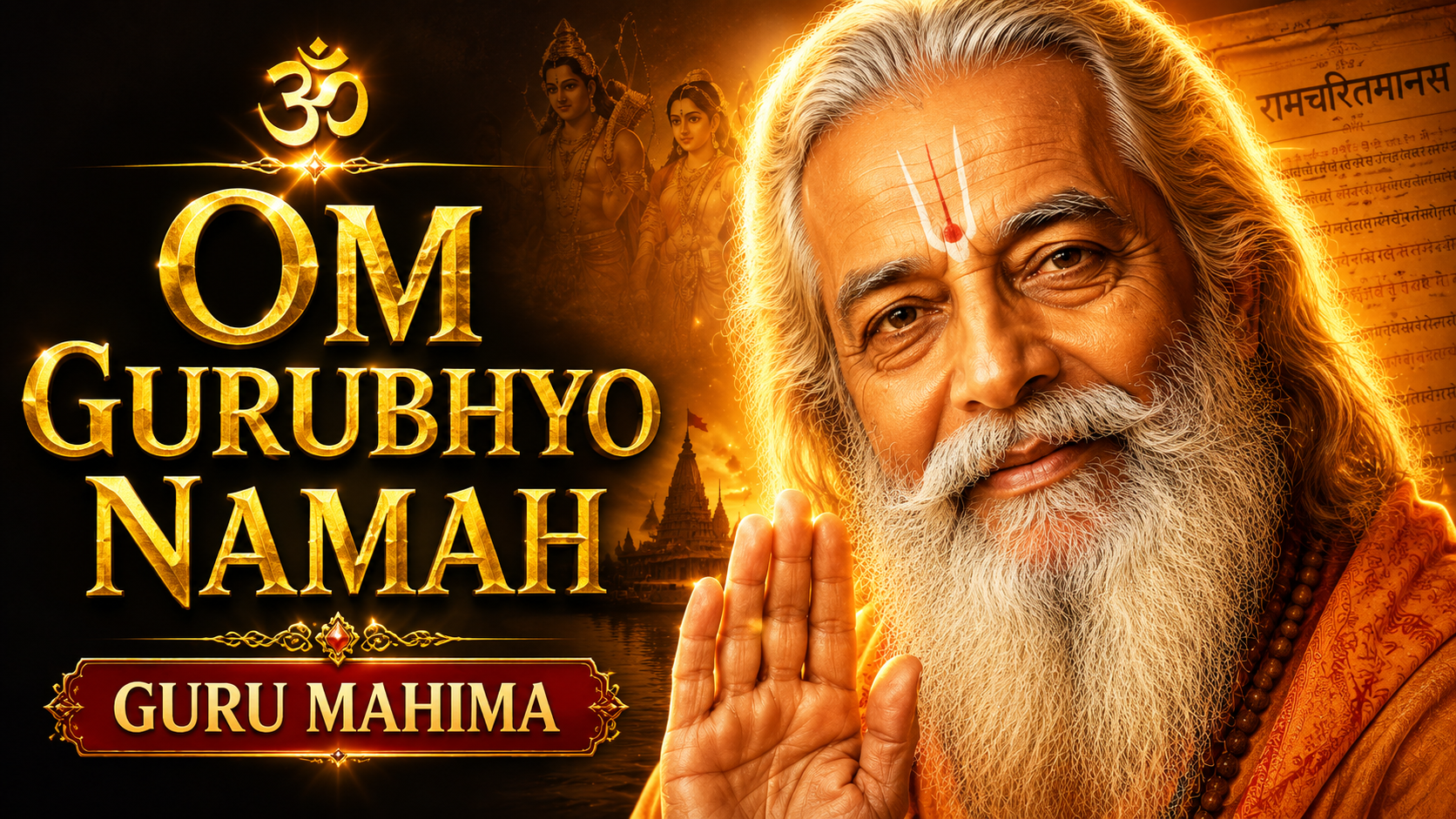
ॐ गुरुभ्यो नमः — salutations to the Guru. Before Goswami Tulsidas begins the story of Shri Ram in the Ramcharitmanas, he does something every seeker in India has done for thousands of years: he bows. Not to a king, not to a deity on a throne, but to the dust on the feet of his Guru. The verses in this song are that bow — the Guru Vandana from the opening of the Bal Kand — and they contain one of the most beautiful ideas in all of devotional literature: that the Guru’s grace is a healing balm for the eyes, and once it is applied, you begin to see the divine treasure hidden everywhere.
The Story Behind the Verses
When Tulsidas sat down in Ayodhya in the 16th century to retell the Ramayana in the language of the people, he knew he was attempting something audacious. The scholars of his time held that sacred stories belonged in Sanskrit. Tulsidas chose Awadhi — the tongue of farmers, mothers, and wandering singers — so that Ram’s story could live in every home.
But before a single word of the story, he composed a series of invocations, and among the most cherished of them is this Guru Vandana. Tulsidas understood a truth found across every tradition: no one crosses the ocean of worldly existence alone. The word guru itself carries the teaching — gu means darkness, ru means the remover. The Guru is the one who removes darkness. And so, before narrating the deeds of Ram, Tulsidas first cleanses his own vision with the dust of his Guru’s feet — because only purified eyes can see the story truly.
Lyrics — ॐ गुरुभ्यो नमः
ॐ गुरुभ्यो नमः
बन्दउँ गुरु-पद-पदुम-परागा
सुरुचि-सुबास सरस अनुरागा
अमिय मूरिमय चूरन चारू
समन सकल भव-रुज परिवारूसुकृत संभु तन बिमल बिभूती
मंजुल मंगल मोद प्रसूती
जन मन मंजु मुकुर मल हरनी
किएँ तिलक गुन गन बस करनीश्रीगुरु पद नख मनि गन जोती
सुमिरत दिव्य दृष्टि हियँ होती
दलन मोह तम सो सप्रकासू
बड़े भाग उर आवइ जासूउघरहिं बिमल बिलोचन ही के
मिटहिं दोष दुख भव रजनी के
सूझहिं रामचरित मनि मानिक
गुपुत प्रगट जहँ जो जेहि खानिकजथा सुअंजन अंजि दृग
साधक सिद्ध सुजान
कौतुक देखहिं सैल बन
भूतल भूरि निधानगुरु पद रज मृदु मंजुल अंजन
नयन अमिय दृग दोष बिभंजन
तेहि करि बिमल बिबेक बिलोचन
बरनउँ रामचरित भव मोचनॐ गुरुभ्यो नमः
Meaning — Verse by Verse
बन्दउँ गुरु-पद-पदुम-परागा / सुरुचि-सुबास सरस अनुरागा
I bow to the pollen-dust of the lotus feet of my Guru — beautiful in taste, sweet in fragrance, and steeped in the nectar of love.
Tulsidas begins with an image of exquisite humility. He does not bow to the Guru’s face or form, but to the paraga — the pollen-fine dust of the Guru’s lotus feet. Even the smallest particle touched by the Guru carries the full sweetness of divine love.
अमिय मूरिमय चूरन चारू / समन सकल भव-रुज परिवारू
That dust is a lovely powder made of the root of immortality, which cures the entire family of diseases born of worldly existence.
Here the dust becomes medicine — ground from amiya moori, the mythical life-restoring herb. The diseases it cures are not of the body but of the soul: craving, envy, fear, restlessness — the whole parivar, the whole extended family of ailments that come with worldly life.
सुकृत संभु तन बिमल बिभूती / मंजुल मंगल मोद प्रसूती
It is like the pure sacred ash adorning the body of Lord Shiva, who is virtue itself — the mother of beauty, auspiciousness, and joy.
Tulsidas now likens the Guru’s foot-dust to the vibhuti on Shiva’s body. Just as that ash is not ordinary ash but the mark of the highest renunciation, the Guru’s dust is not ordinary dust — it gives birth to everything auspicious.
जन मन मंजु मुकुर मल हरनी / किएँ तिलक गुन गन बस करनी
It cleanses the grime from the beautiful mirror of the devotee’s mind; worn as a tilak, it brings the whole host of virtues under one’s sway.
The mind is a mirror, says Tulsidas — beautiful by nature but clouded by the dust of the world. Paradoxically, it is another dust, the Guru’s, that wipes the mirror clean. When worn on the forehead as tilak, it doesn’t just symbolize devotion; it magnetizes every good quality toward the devotee.
श्रीगुरु पद नख मनि गन जोती / सुमिरत दिव्य दृष्टि हियँ होती
The nails of the Guru’s feet gleam like a cluster of gems; merely remembering their light awakens divine vision in the heart.
Even the toenails of the Guru shine like jewels — and remembrance alone, sumiran, is enough. You need not be in the Guru’s physical presence; the inner remembering itself lights the lamp of divine sight.
दलन मोह तम सो सप्रकासू / बड़े भाग उर आवइ जासू
That radiance crushes the darkness of delusion; greatly fortunate is the one in whose heart it dawns.
This light is not passive — it dalan, actively destroys, the darkness of moha, our deep confusion about what is real and what matters. And Tulsidas reminds us this dawn is not earned by cleverness; it arrives by bade bhag — great good fortune, grace.
उघरहिं बिमल बिलोचन ही के / मिटहिं दोष दुख भव रजनी के
With that light, the clear inner eyes of the heart open, and the faults and sorrows of the long night of worldly existence are erased.
Worldly life, says Tulsidas, is a rajani — a long night in which we stumble. The Guru’s grace is daybreak. When the heart’s eyes open, the shapes we feared in the dark are seen for what they truly are.
सूझहिं रामचरित मनि मानिक / गुपुत प्रगट जहँ जो जेहि खानिक
Then the gems and rubies of Shri Ram’s story become visible — hidden or manifest, in whatever mine each one lies.
Now Tulsidas reveals why he needed this vision: the Ramcharit is a treasure-field, and its deepest jewels are buried. Ordinary reading skims the surface; graced eyes see the hidden veins of gold running through every episode of Ram’s life.
जथा सुअंजन अंजि दृग… भूतल भूरि निधान
Just as seekers, adepts, and the wise, applying the magical collyrium to their eyes, behold with wonder the countless treasures hidden in mountains, forests, and beneath the earth.
In Indian lore there was a legendary anjan, a magical eye-salve said to reveal treasure buried in the ground. Tulsidas uses this folk image everyone in his audience knew: with the right anointing of the eyes, the same ordinary world shows you its hidden riches.
गुरु पद रज मृदु मंजुल अंजन / नयन अमिय दृग दोष बिभंजन
The dust of the Guru’s feet is that soft and lovely collyrium — nectar for the eyes, destroying every defect of vision.
The metaphor completes itself. The magical salve is real, and it is the Guru’s foot-dust. Applied to the inner eye, it is amiya — pure nectar — and it removes not defects of the eyeball but defects of seeing itself: seeing the world without seeing the divine in it.
तेहि करि बिमल बिबेक बिलोचन / बरनउँ रामचरित भव मोचन
Having brightened the eyes of discernment with that salve, I now narrate the Ramcharit, which liberates from worldly existence.
Only now — vision purified, discernment awakened — does Tulsidas permit himself to begin the story. It is the perfect final teaching of the Vandana: prepare the instrument before you attempt the music. Cleanse the eye before you look at the sacred.
Why This Vandana Speaks Across All Traditions
Though these verses come from the Ramcharitmanas, the reverence they carry belongs to every path. The Sikh tradition opens with the Guru at its very heart. The Sufi disciple bows to the murshid who walks them toward the Beloved. The Sant Mat lineages teach that without the living guide, the inner sound cannot be found. Tulsidas’s Guru Vandana gives voice to what all of them know: the light that removes our darkness usually reaches us through someone — a teacher, a parent, a saint, a moment of grace — and gratitude to that someone is itself a doorway to the Divine.
That is why this song opens and closes with ॐ गुरुभ्यो नमः — not a bow to one guru, but to all Gurus, in every form they have taken in your life.
Listen & Watch
🎧 Watch the full music video: Om Gurubhyo Namah — Guru Vandana | EkOmkaar Musicals
🎵 Listen on Spotify: Om Gurubhyo Namah on Spotify
🔔 Subscribe for more devotional music: EkOmkaar Musicals on YouTube
One universal sound, one connecting music, one source of infinite wisdom.
More from EkOmkaar Musicals
- Chala Vahi Des — चालाँ वाही देस — Lyrics & Meaning | Meera Bai Bhajan
- Main Girdhar Ke Ghar Jaun — मैं गिरधर के घर जाऊँ — Lyrics & Meaning | Meera Bai Bhajan
- Jago Bansi Ware Lalna & Barse Badariya Sawan Ki — Lyrics & Meaning | Meera Bai Bhajan
- Shri Radhe Rani De Daro Bansuri Mori — Lyrics & Meaning | Meera Bai Bhajan
- Shri Radhe Rani De Daro Bansuri Mori — Lyrics & Meaning | Meera Bai Bhajan
- Life’s a Party — Lyrics & Meaning | A Feel-Good Anthem of Joy | EkOmkaar Musicals
- Life’s a Party — Lyrics & Meaning | A Feel-Good Anthem of Joy | EkOmkaar Musicals
- Ram Mahima Mantra | Shri Ram Jai Ram Jai Jai Ram — Lyrics & Meaning