
About This Song
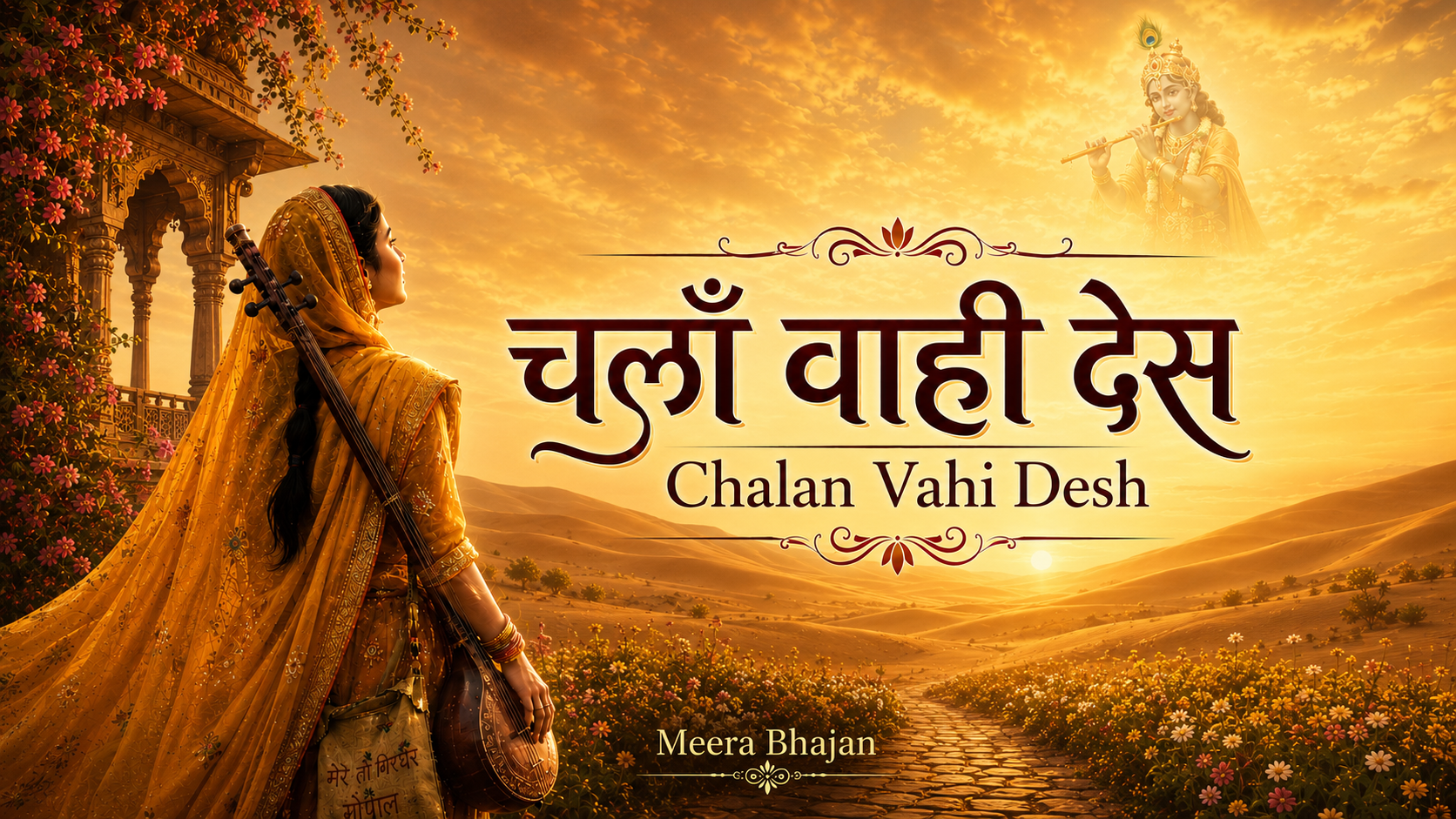
Chala Vahi Des — “Let us go to that land” — is one of the shortest pads Meera Bai ever composed, and one of the most complete. In just a handful of lines, a whole life’s decision is made: Meera is leaving for the country where her Beloved lives, and nothing else — not clothing, not adornment, not what the world will call her — matters in the slightest. Bridal red or renunciate’s saffron, pearls in her hair or hair left loose and wild: kaho to, “just say the word,” she answers to every option, because the destination is all. In this EkOmkaar Musicals rendition, the pad’s quiet resolve becomes a walking song — the sound of a soul that has already left.
The Lyrics | गीत के बोल
चालाँ वाही देस
प्रीतम पावाँ
चलाँ वाही देस
कहो तो कुसुमल साड़ी रंगावाँ
कहो तो भगवा भेस
कहो तो मोतियन माँग भरावाँ
कहो छिरकावाँ केस
मीरा के प्रभु गिरधर नागर
सुण गयो बिड़द नरेस
चालाँ वाही देस
प्रीतम पावाँ
चलाँ वाही देस
Meaning of the Lyrics
चालाँ वाही देस, प्रीतम पावाँ… — “Let us go to that very land — the land where I shall find my Beloved.” The pad opens mid-departure. There is no argument, no lament, no looking back at Mewar’s palaces. For Meera, “that land” is wherever Girdhar is — Vrindavan on the map, and union with the Divine beyond it. The soul has decided; the feet are simply following.
कहो तो कुसुमल साड़ी रंगावाँ, कहो तो भगवा भेस… — Then comes the pad’s exquisite center: a series of offered choices, each pair holding two opposite lives. “Say the word, and I’ll dye my sari kusumal — the deep bridal red of the safflower. Or say it, and I’ll wear bhagwa — the ochre robes of a renunciate.” Bride or sannyasini — Meera holds both costumes up with the same steady hand.
कहो तो मोतियन माँग भरावाँ, कहो छिरकावाँ केस… — The same surrender, one step more intimate: “Say it, and I’ll fill the parting of my hair with pearls” — the ornament of a married woman, adorned for her lord — “or say it, and I’ll let my hair down, loose and unbound” — the sign of the ascetic, of one who has scattered every vanity. The world sees red sari and saffron robe as opposite destinies; Meera sees them as two uniforms for the same journey. Her identity does not live in any of them. It lives in the Beloved.
मीरा के प्रभु गिरधर नागर, सुण गयो बिड़द नरेस… — The pad closes with Meera’s signature and a gentle, confident reminder: the King has heard of his own birad. In Rajasthani devotional idiom, birad is the Lord’s famed vow — his reputation for never abandoning those who take refuge in him. Meera is saying, in effect: “You are known everywhere as the protector of your own, Girdhar Nagar. I have heard of that vow — and I am coming to collect on it.” It is faith spoken not as a plea, but as a certainty.
History & Devotion
This pad belongs to the padavali of Meera Bai (c. 1498–1547), and its handful of lines compress her whole biography: the princess who did, in fact, walk out of the Mewar court, who did exchange royal silks for a bhajan-singer’s simplicity, and who did make her way to “that land” — Vrindavan, and finally Dwarka, where tradition says she merged into her Girdhar’s image. What she offers in the song, she performed in her life.
In the twentieth century, this little pad found an enormous second life when Lata Mangeshkar recorded it in the mid-1970s in an album of Meera bhajans composed by her brother Hridaynath Mangeshkar — a recording so beloved that for many listeners its title became synonymous with Meera herself. The pad’s theme, meanwhile, is one of the deepest in all sant literature: the indifference of the true lover of God to outer garb. Kabir mocked those who thought robes made the renunciate; the Sikh Gurus taught that neither householder’s dress nor yogi’s ash matters beside remembrance of the One; the Sufis said the dervish’s cloak means nothing without the burning heart. Meera’s version is the tenderest of them all — she’ll wear anything you like, she says, as long as the road leads to Him.
This EkOmkaar Musicals rendition sings her departure again — for every heart that has ever packed lightly and set out for that land.
Listen & Watch
▶️ Watch on YouTube | 🎧 Listen on Spotify
राधे राधे 🙏
More from EkOmkaar Musicals
- Main Girdhar Ke Ghar Jaun — मैं गिरधर के घर जाऊँ — Lyrics & Meaning | Meera Bai Bhajan
- Jago Bansi Ware Lalna & Barse Badariya Sawan Ki — Lyrics & Meaning | Meera Bai Bhajan
- Shri Radhe Rani De Daro Bansuri Mori — Lyrics & Meaning | Meera Bai Bhajan
- Shri Radhe Rani De Daro Bansuri Mori — Lyrics & Meaning | Meera Bai Bhajan
- Life’s a Party — Lyrics & Meaning | A Feel-Good Anthem of Joy | EkOmkaar Musicals
- Life’s a Party — Lyrics & Meaning | A Feel-Good Anthem of Joy | EkOmkaar Musicals
- Ram Mahima Mantra | Shri Ram Jai Ram Jai Jai Ram — Lyrics & Meaning
- ram-mahima-mantra-blog