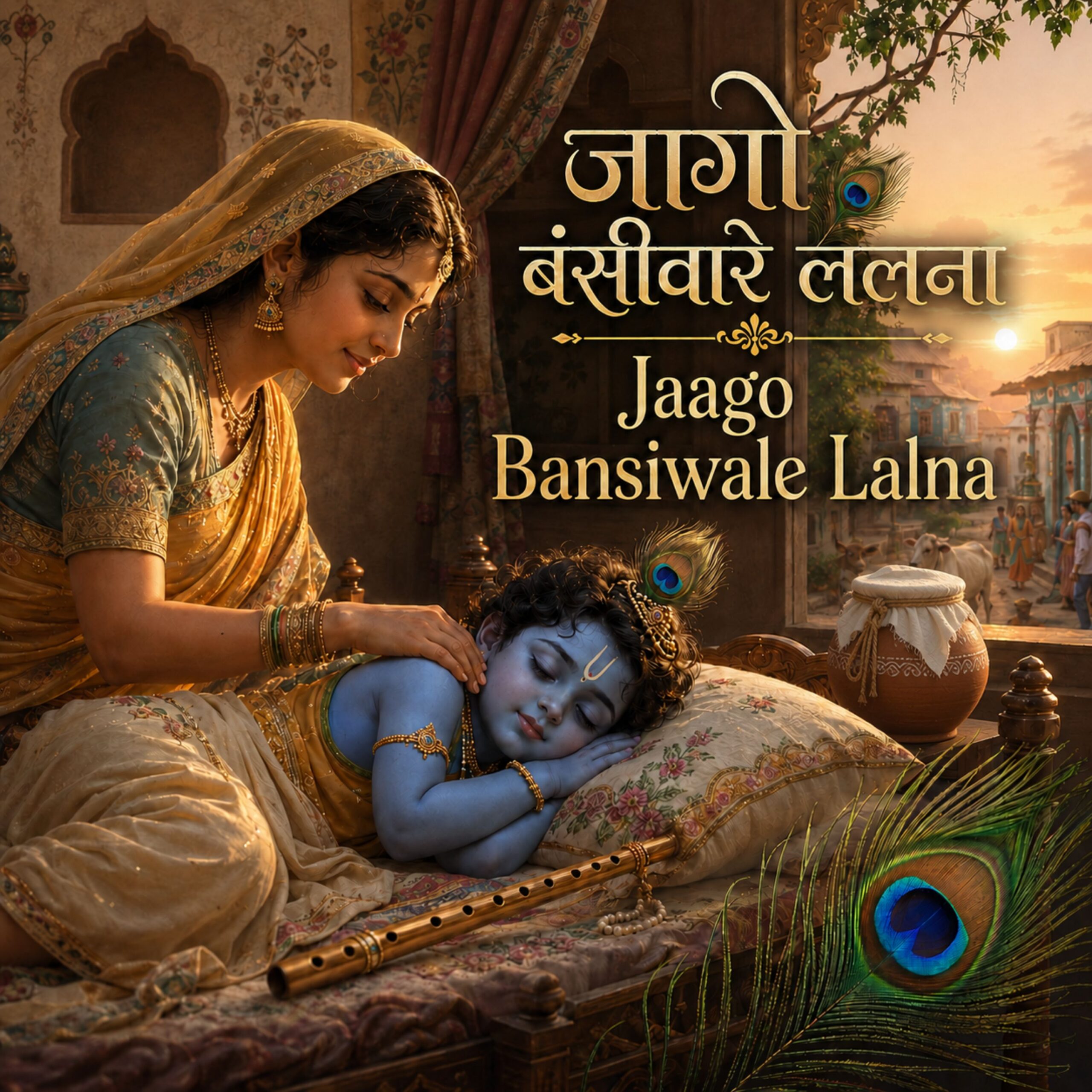

About This Song
This EkOmkaar Musicals rendition weaves together two of Meera Bai‘s most beloved pads — Jago Bansi Ware Lalna, a tender dawn-song in which Mother Yashoda wakes baby Krishna, and Barse Badariya Sawan Ki, Meera’s rapturous monsoon song. Together they are known to millions as Bhor aur Barkha — “Dawn and Rain.” One pad opens the day in Gokul with churning curd and jingling bangles; the other opens the heart as the first Sawan clouds gather. Between morning light and monsoon rain, both songs are really about one thing: the sweetness of waiting for Krishna.
The Lyrics | गीत के बोल
जागो बंसीवारे ललना
जागो मोरे प्यारे
रजनी बीती, भोर भयो है
घर-घर खुले किंवारे
गोपी दही मथत
सुनियत हैं कंगना के झनकारे
जागो बंसीवारे ललना
जागो मोरे प्यारे
उठो लालजी, भोर भयो है
सुर-नर ठाढ़े द्वारे
ग्वाल-बाल सब करत कुलाहल
जय-जय सबद उचारै
जागो बंसीवारे ललना
जागो मोरे प्यारे
माखन-रोटी हाथ मँह लीनी
गउवन के रखवारे
मीरा के प्रभु गिरधर नागर
सरण आयाँ को तारै
जागो बंसीवारे ललना
जागो मोरे प्यारे
बरसे बदरिया सावन की
सावन की मन-भावन की
जागो बंसीवारे ललना
जागो मोरे प्यारे
सावन में उमग्यो मेरो मनवा
भनक सुनी हरि आवन की
उमड़-घुमड़ चहुँदिस से आया
दामिन दमकै झर लावन की
जागो बंसीवारे ललना
जागो मोरे प्यारे
नन्हीं-नन्हीं बूँदन मेहा बरसे
शीतल पवन सुहावन की
मीरा के प्रभु गिरधर नागर
आनंद-मंगल गावन की
Meaning of the Lyrics
जागो बंसीवारे ललना, जागो मोरे प्यारे… — “Wake up, my flute-playing darling! Wake up, my beloved!” This is Yashoda’s voice at dawn in Gokul. The night has passed, morning has broken, and door after door is opening across the village. Meera, the princess of Mewar, slips entirely into the heart of a mother in Braj — this is vatsalya bhava, loving God as one’s own child.
गोपी दही मथत, सुनियत हैं कंगना के झनकारे… — The morning is painted in sounds: the gopis are already churning curd, and you can hear the jingling of their bangles. Gods and men stand waiting at the door; the cowherd boys raise a joyful clamor of “Jai! Jai!” All of Gokul is awake — only its little Lord still sleeps.
माखन-रोटी हाथ मँह लीनी, गउवन के रखवारे… — Yashoda coaxes him with breakfast: makhan and roti are ready in hand for the keeper of the cows. And then Meera’s signature turns the lullaby into theology: Meera ke prabhu Girdhar Nagar, saran aayaan ko taarai — “Meera’s Lord, Girdhar Nagar, delivers all who come to his refuge.” The sleeping child of Gokul is the savior of the surrendered.
बरसे बदरिया सावन की… — And now the second pad: “The clouds of Sawan are raining — Sawan, the delight of the heart!” Meera’s mind surges with joy, because in the gathering monsoon she has heard a bhanak — a faint rumor, a whisper — that Hari is coming. In the poetry of Braj, the rainy season is the season of reunion; dark clouds are the color of Krishna himself.
उमड़-घुमड़ चहुँदिस से आया… — The clouds mass and billow from all four directions; lightning flashes, announcing the coming downpour. Then the rain arrives — nanhi nanhi boondan, in tiny, tender drops — and a cool, soothing breeze begins to blow. Meera’s answer to all this beauty is the last line: it is a time for singing songs of anand-mangal — joy and auspiciousness. Where the first pad ends in refuge, the second ends in celebration.
History & Devotion
Both pads flow from the pen of Meera Bai, the 16th-century Rajput princess-saint whose love for her Girdhar Gopal outshone crown and convention. Paired together as Bhor aur Barkha, these two songs have introduced generations of Indian schoolchildren to Meera’s poetry — and long before the classroom, they lived in temple courtyards and home shrines as morning and monsoon singing.
Jago Bansi Ware Lalna belongs to the prabhati tradition — dawn songs sung to wake the deity, still performed every morning in Krishna temples from Nathdwara to Vrindavan, where the Lord is treated as a living, sleeping child. Barse Badariya belongs to the equally rich tradition of Sawan and Malhar songs, where the monsoon month — beloved of Shiva’s devotees and Krishna’s alike — becomes a metaphor for grace descending. Classical musicians have long set it in rain-drenched ragas, and its lines rise every year as the first Sawan clouds gather.
Heard side by side, the two pads reveal the full range of Meera’s heart: the mother’s tenderness of Gokul and the lover’s thrill of the monsoon — dawn breaking outside the window, and dawn breaking within. This EkOmkaar Musicals rendition offers them as one continuous morning of the soul.
Listen & Watch
राधे राधे 🙏
More from EkOmkaar Musicals
- Shri Radhe Rani De Daro Bansuri Mori — Lyrics & Meaning | Meera Bai Bhajan
- Shri Radhe Rani De Daro Bansuri Mori — Lyrics & Meaning | Meera Bai Bhajan
- Life’s a Party — Lyrics & Meaning | A Feel-Good Anthem of Joy | EkOmkaar Musicals
- Life’s a Party — Lyrics & Meaning | A Feel-Good Anthem of Joy | EkOmkaar Musicals
- Ram Mahima Mantra | Shri Ram Jai Ram Jai Jai Ram — Lyrics & Meaning
- ram-mahima-mantra-blog
- om-gurubhyo-namah-guru-vandana-blog
- Bullah Ki Jaana Main Kaun — بلھا کی جاناں مَیں کون — Bulleh Shah Kalam | EkOmkaar Musicals