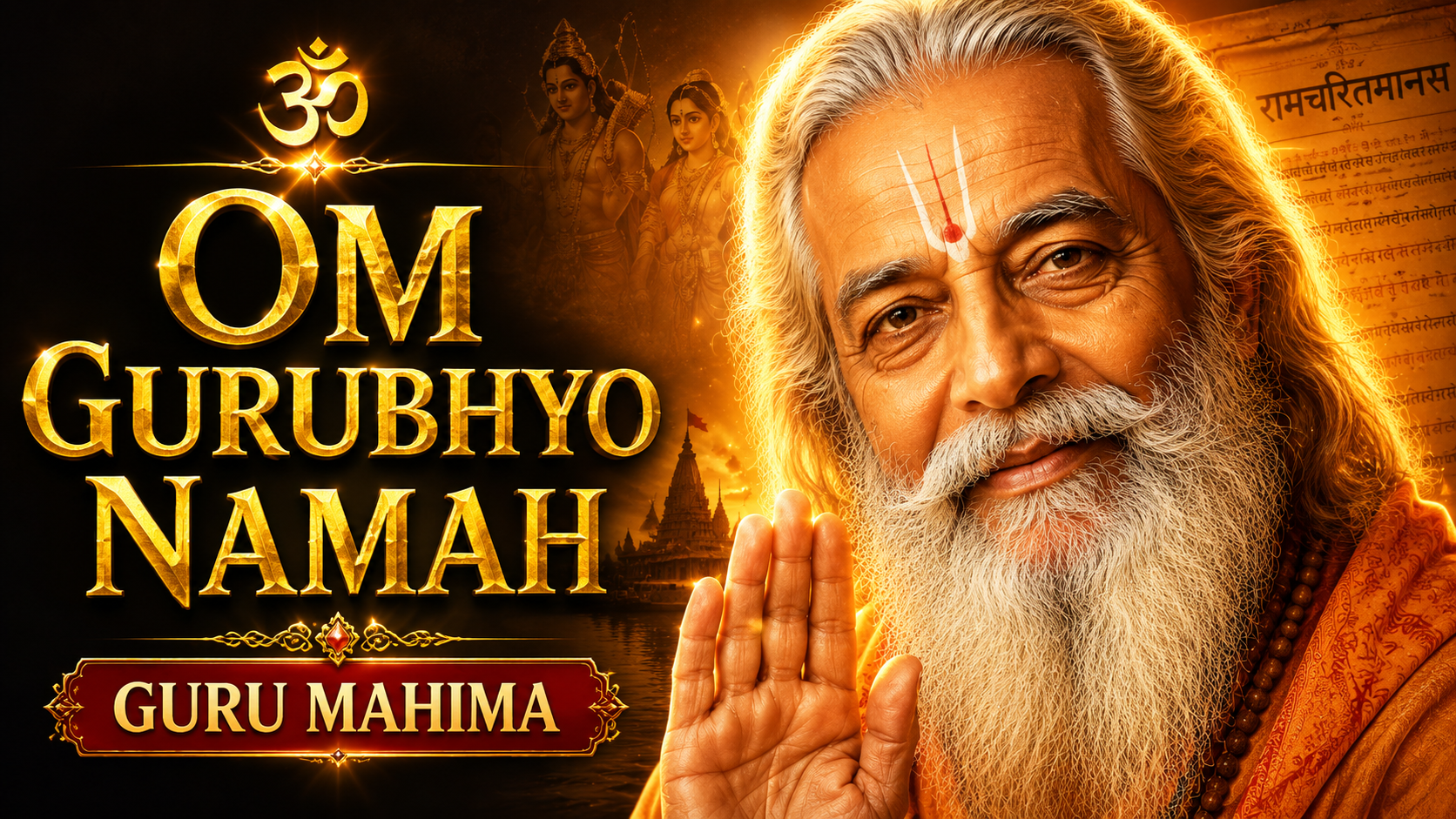
On the full moon of Ashadha, India stops to say thank you. Not to a god on a distant throne, not to a king or a conqueror — but to the teacher. Guru Purnima, falling on Wednesday, July 29 in 2026, is perhaps the only festival in the world dedicated entirely to gratitude: gratitude to every hand that ever steadied us, every voice that ever said “look again,” every light that ever found us in the dark.
What Does “Guru” Really Mean?
The word itself carries the whole teaching. In Sanskrit, gu means darkness and ru means the remover. The Guru is the remover of darkness — the one who dispels ignorance and reveals what was always there, waiting to be seen.
Notice what this definition does not say. It does not say the Guru must wear robes, sit on a dais, or belong to any particular lineage. Anyone who has removed darkness from your life has been, in that moment, your Guru: the mother who taught you your first words, the teacher who refused to give up on you, the friend who told you a hard truth, the stranger whose kindness changed your direction, and the silent inner light that guides you when no one else is near. Guru Purnima is the day we bow to all of them.
The Story: Why This Full Moon?
The Ashadha full moon is honored as Vyasa Purnima — the birth anniversary of Maharishi Ved Vyasa, one of the greatest sages in human memory. It was Vyasa who gathered the vast ocean of Vedic wisdom and organized it into the four Vedas, who composed the Mahabharata, the Brahma Sutras, and the Puranas. Without Vyasa, the wisdom of the rishis might have scattered like seeds in the wind. He was, in the deepest sense, the teacher of all teachers — and so his birthday became the day for honoring every Guru who came after.
But the beauty of this full moon is that it belongs to no single tradition. Buddhists honor it as the day the Buddha gave his first sermon at Sarnath, turning the wheel of dharma for his first five disciples. Jains remember it as the day Lord Mahavira accepted his first disciple. In the yogic tradition, it is celebrated as the day Adi Yogi — Shiva himself — became Adi Guru, the first teacher, transmitting the science of yoga to the seven sages.
One moon. Many traditions. The same bow.
The Guru Across Every Path
This universality is no coincidence — it points to something true. The Sikh path is literally named for the Guru: from Guru Nanak Dev Ji through the ten Gurus to the eternal Guru Granth Sahib, the entire tradition rests on the Guru’s word, the Shabd. The Sufi seeker bows to the murshid, the guide who walks them stage by stage toward the Beloved. The Sant Mat lineages teach that the inner sound current cannot be found without a living guide who has traveled the path. And the Vedic tradition sings it plainly: the Guru is Brahma, the Guru is Vishnu, the Guru is Maheshwara — because the Divine reaches us through the one who teaches us.
Different languages, different lands, different centuries — and underneath, one universal truth: no one crosses the ocean alone.
How Guru Purnima Is Observed
Across India and the world, devotees mark the day with Guru Puja — offering flowers, fruit, and reverence to their teacher or the teacher’s image. Many perform padapuja, honoring the Guru’s feet or sandals, the humblest point of contact with grace. Ashrams hold satsangs and discourses; students visit old teachers; disciples renew their commitment to the path. And countless people keep it simply: a phone call to a mentor, a silent prayer of thanks, a moment of remembering everyone who shaped them.
The rituals vary. The essence never does: gratitude, expressed.
A Song for the Guru — ॐ गुरुभ्यो नमः
Five centuries ago, before Goswami Tulsidas dared to write a single line of the Ramcharitmanas, he first bowed to his Guru in verses of astonishing beauty — comparing the dust of the Guru’s feet to a healing balm that, applied to the eyes, lets you see the divine treasure hidden everywhere. This Guru Vandana, “Bandau Guru Pad Padum Paraga,” is the heart of our Guru Purnima offering.
🎧 Watch the full music video: Om Gurubhyo Namah — Guru Vandana | EkOmkaar Musicals
🎵 Listen on Spotify: Om Gurubhyo Namah on Spotify
📖 Read the full lyrics and verse-by-verse meaning: Om Gurubhyo Namah — Guru Vandana from Ramcharitmanas
A Simple Practice for This Guru Purnima
You don’t need a temple or a ritual manual. This July 29, try this: sit quietly for a few minutes and let the faces come — everyone who ever removed some darkness from your life. Name them, one by one, silently. For each one, offer the same three words Tulsidas offered: Om Gurubhyo Namah — I bow to the Gurus. If one of them is still reachable, reach out. Gratitude spoken aloud is the oldest puja of all.
And if music is your doorway, let the song play while you remember. That is what it was made for.
🔔 Subscribe for more devotional music: EkOmkaar Musicals on YouTube
One universal sound, one connecting music, one source of infinite wisdom.
More from EkOmkaar Musicals
- Om Gurubhyo Namah — बन्दउँ गुरु पद पदुम परागा — Guru Vandana from Ramcharitmanas | EkOmkaar Musicals
- Om Gurubhyo Namah — बन्दउँ गुरु पद पदुम परागा — Guru Vandana from Ramcharitmanas | EkOmkaar Musicals
- Chala Vahi Des — चालाँ वाही देस — Lyrics & Meaning | Meera Bai Bhajan
- Main Girdhar Ke Ghar Jaun — मैं गिरधर के घर जाऊँ — Lyrics & Meaning | Meera Bai Bhajan
- Jago Bansi Ware Lalna & Barse Badariya Sawan Ki — Lyrics & Meaning | Meera Bai Bhajan
- Shri Radhe Rani De Daro Bansuri Mori — Lyrics & Meaning | Meera Bai Bhajan
- Shri Radhe Rani De Daro Bansuri Mori — Lyrics & Meaning | Meera Bai Bhajan
- Life’s a Party — Lyrics & Meaning | A Feel-Good Anthem of Joy | EkOmkaar Musicals