
About This Song
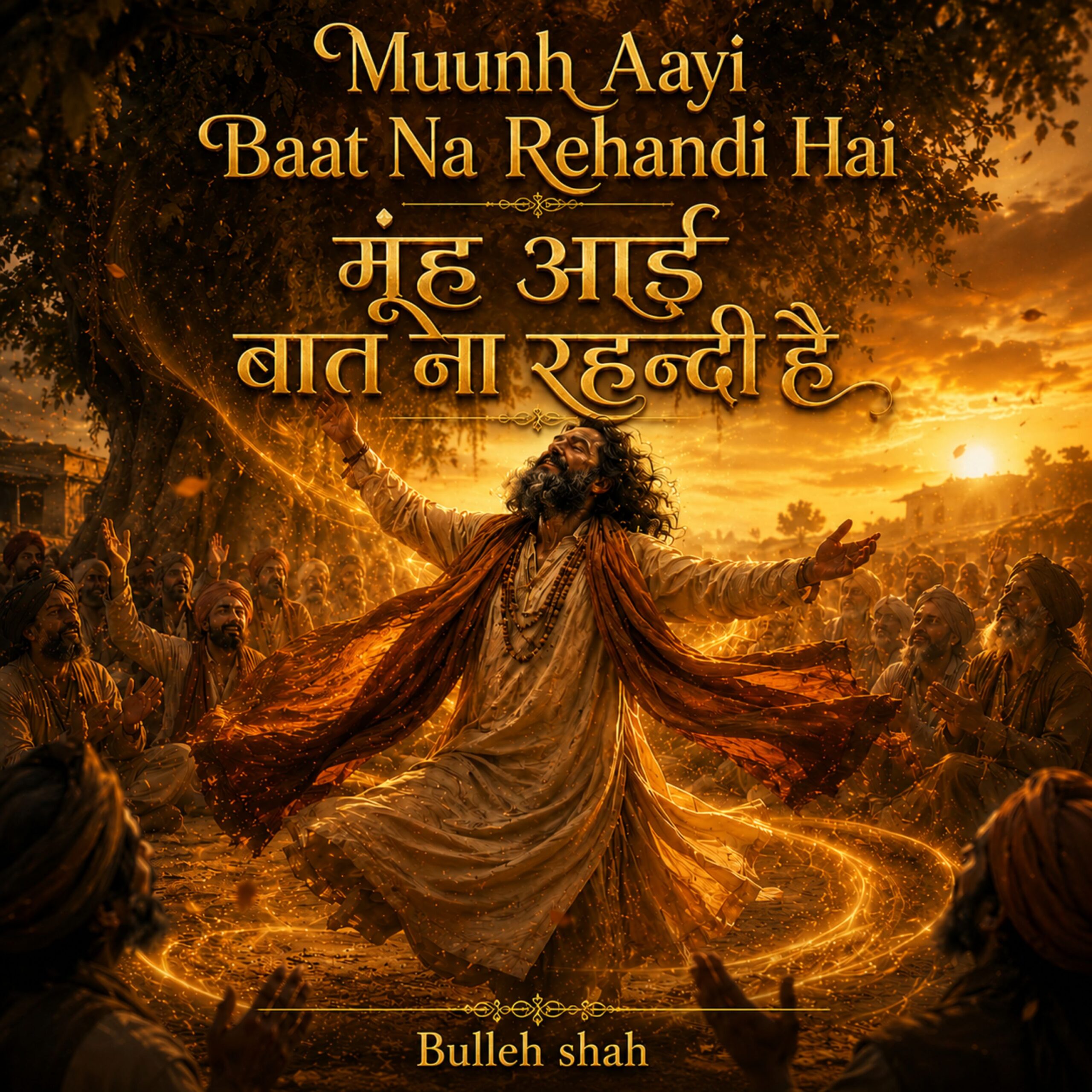
Munh Aayi Baat Na Rehandi Hai is one of Bulleh Shah’s most searching kalams — a meditation on why truth, once it rises to the lips, refuses to stay contained. The refrain that gives the poem its name repeats after nearly every verse like a returning wave: a spoken thing cannot be called back once it has left the mouth. Bulleh Shah uses this simple observation about speech as a doorway into something much larger — the impossibility of keeping ultimate truth hidden once it has been glimpsed.
The mood of the composition is urgent and unguarded. Unlike some of his gentler bhajans of longing, this kalam has the tone of a teacher thinking aloud, working through a real difficulty: the tension between what the seeker knows in their depths and what is safe to say in the world. It sits in the tradition of Punjabi Sufi kalam, sung and repeated for generations precisely because that tension between inner realization and outer silence is one every sincere seeker eventually meets.
Lyrics
झूठ आखां ते कुझ बचदा ए
सच्च आख्यां भांबड़ मचदा ए
जी दोहां गल्लां तों जचदा ए
जच जच के जेहवा कहन्दी ए
मूंह आई बात ना रहन्दी एजिस पाआ भेद कलन्दर दा
राह खोज्या आपने अन्दर दा
ओह वासी है सुक्ख मन्दर दा
जिथे कोई ना चढ़दी लहन्दी ए
मूंह आई बात ना रहन्दी एइक लाज़म बात अदब दी ए
सानूं बात मलूमी सभ दी ए
हर हर विच सूरत रब्ब दी ए
किते ज़ाहर किते छुपेंदी ए
मूंह आई बात ना रहन्दी एएथे दुनियां विच अन्हेरा ए
ऐह तिलकन बाज़ी वेहड़ा ए
वड़ अन्दर वेखो केहड़ा ए
क्युं खफ़तन बाहर ढूंडेदी ए
मूंह आई बात ना रहन्दी एएथे लेखा पायों पसारा ए
इहदा वखरा भेद न्यारा ए
इह सूरत दा चमकारा ए
जिवें चिनग दारू विच पैंदी ए
मूंह आई बात ना रहन्दी एकिते नाज़ अदा दिखलाईदा
किते हो रसूल मिलाईदा
किते आशक बण बण आईदा
किते जान जुदाई सहन्दी ए
मूंह आई बात ना रहन्दी एजदों ज़ाहर होए नूर होरी
जल गए पहाड़ कोह-तूर होरी
तदों दार चढ़े मनसूर होरी
ओथे शेखी पेश ना वैंदी ए
मूंह आई बात ना रहन्दी एजे ज़ाहर करां इसरार ताईं
सभ भुल्ल जावन तकरार ताईं
फिर मारन बुल्ल्हे यार ताईं
एथे मख़फ़ी गल्ल सोहेंदी ए
मूंह आई बात ना रहन्दी एअसां पढ़आ इलम तहकीकी ए
ओथे इको हरफ़ हकीकी ए
होर झगड़ा सभ वधीकी ए
ऐवें रौला पा पा बहन्दी ए
मूंह आई बात ना रहन्दी एए शाह अकल तूं आया कर
सानूं अदब अदाब सिखाइआ कर
मैं झूठी नूं समझाइआ कर
जो मूरख माहनूं कहन्दी ए
मूंह आई बात ना रहन्दी एवाह वाह कुदरत बेपरवाही ए
देवे कैदी दे सिर शाही ए
ऐसा बेटा जाएया माए
सभ कलमा उस दा कहन्दी ए
मूंह आई बात ना रहन्दी एइस आज़िज़ दा की हीला ए
रंग ज़रद ते मुक्खड़ा पीला ए
जिथे आपे आप वसीला ए
ओथे की अदालत कहन्दी ए
मूंह आई बात ना रहन्दी एबुल्ल्हा शाह असां थीं वक्ख नहीं
बिन शाह थीं दूजा कक्ख नहीं
पर वेखन वाली अक्ख नहीं
ताहीं जान जुदाईआं सहन्दी ए
मूंह आई बात ना रहन्दी ए
Meaning of the Lyrics
The opening lines set up the poem’s central contrast: a lie can be told and something of it will still hold together, but truth, once spoken, sets everything ablaze. Both statements can be tested and felt to be true — and once that has been weighed and understood, the tongue simply will not stay quiet. This is the heart of the refrain: munh aayi baat na rehandi hai — a truth that has reached the mouth does not remain unspoken.
Bulleh Shah then turns toward the seeker who has found the secret of a kalandar — a wandering mystic, one who has renounced worldly attachment. That secret is found not by searching outward but by searching within one’s own self; the true dwelling place is a “temple of peace” where nothing rises or falls, where the restless coming-and-going of ordinary life has quieted. From there the poem insists on adab — reverence and humility — because, it says plainly, the face of the Divine shows itself in every face, sometimes openly and sometimes hidden. Why look outward in confusion, the poet asks, when the answer sits within, waiting to be turned toward?
The verses that follow grow bolder. Bulleh Shah describes moments when a lover’s gestures reveal themselves, when a Messenger is met, when one arrives as a true lover — and moments of painful separation that must simply be endured. Here the kalam reaches for its most striking image: when that hidden light became fully manifest, even the mountains of Koh-e-Tur were consumed by fire — and it was in that same unveiling that Mansur was led to the gallows. This is a direct reference to Mansur Al-Hallaj, the mystic executed for declaring “Ana’l-Haq” (“I am the Truth”) — a declaration of union with the Divine that orthodoxy could not permit spoken aloud. Bulleh Shah is naming the real cost of letting an inner truth become outer speech, and admitting that at that threshold, no pride or self-importance survives.
And yet the poem does not resolve into safe silence. If the secret were fully revealed, Bulleh Shah says, all argument would cease — but the world would also turn on the one who spoke it, as it turned on Mansur. Better, he suggests, that such a hidden matter stays becomingly veiled. He contrasts real, experiential knowledge (haqiqi ilm) with mere argumentative learning (tehqiqi ilm), calling the endless disputes of scholars just noise stacked upon noise next to the single, sufficient truth realized within. The closing verses turn personal and unguarded — Bulleh Shah asking for wisdom and courtly manners from his own teacher, calling himself the false one who needs correcting, even as he insists that he and the Divine are not separate, that nothing exists apart from that Shah. What is missing, he says with characteristic humility, is not the truth but the eye capable of seeing it — and it is that missing eye which makes separation something that must still be borne.
History & Devotion
Bulleh Shah (traditionally dated to the late seventeenth and early eighteenth centuries) remains one of the most beloved Sufi poets of the Punjab, a disciple of the Qadiri Sufi master Shah Inayat Qadiri of Lahore. His kalams were composed to be sung, not merely read — carried forward through oral and musical tradition long before being written down, which is part of why they continue to live so vividly in devotional music today. He wrote in Punjabi rather than the more scholarly Persian or Arabic of his era, deliberately choosing the language of ordinary people to carry the most difficult truths of divine union.
The reference to Mansur Al-Hallaj running through this kalam situates Bulleh Shah within a long lineage of mystics who wrestled with the danger and necessity of speaking what union with the Divine actually reveals. Al-Hallaj’s execution in the tenth century for uttering “Ana’l-Haq” became, for later Sufi poets across Punjabi, Persian, and Urdu traditions, a recurring symbol — not of failure, but of a truth so complete it could not be contained by the world it was spoken into. Bulleh Shah invokes that memory here not as distant history but as a mirror for his own struggle between silence and speech, between what adab requires and what an awakened heart cannot help but say.
Listen & Watch
ਇਸ਼ਕ ਅੱਲਾਹ 🙏
More from EkOmkaar Musicals
- Haaji Log Makke Nu Jaande — حاجی لوگ مکے نوں جاندے — Bulleh Shah Kalam
- Golden Hearts, Golden Jubilee — Mom & Dad, Forever Our Home (Lyrics & Meaning)
- Bullah Ki Jaana Main Kaun — بلھا کی جاناں مَیں کون — Bulleh Shah Kalam
- Muunh Aayi Baat Na Rehandi Hai — ਮੂੰਹ ਆਈ ਗੱਲ ਨਾ ਰਹਿੰਦੀ ਹੈ — Bulleh Shah Kalam | EkOmkaar Musicals