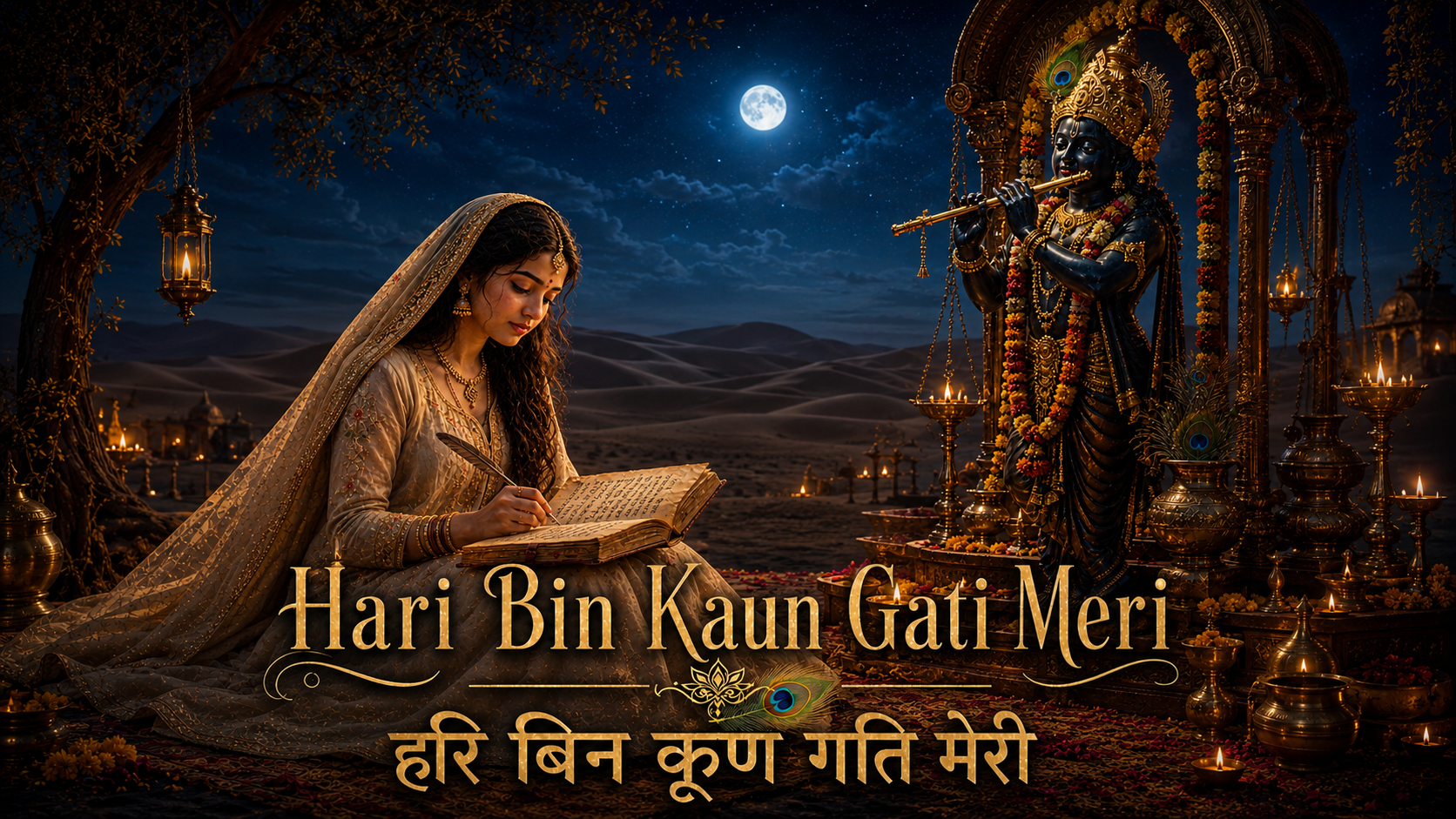
About This Song
Hari Bin Kaun Gati Meri is one of Meera Bai’s most direct and unguarded pleas — a single, repeated cry that returns after every verse like a heartbeat: without Hari, what refuge do I have? Where some of Meera’s compositions dwell in the sweetness of remembered love, this bhajan sits closer to desperation — the voice of someone who has burned every other bridge and is left facing Krishna alone, with nothing else to fall back on.
The mood is one of total surrender rather than longing alone. Meera does not ask to be brought closer in stages; she declares herself already his — his maid, his servant — and asks only that the one relationship she has staked everything on be honoured. It is devotional music at its most stripped-down: no scenery, no springtime, no flute in the distance — just a soul naming its only shelter.
Lyrics
हरि बिन कूण गति मेरी।
तुम मेरे प्रतिपाल कहिए मैं रावरी चेरी॥
हरि बिन कूण गति मेरी।
आदि अंत निज नाँव तेरो हीया में फेरी।
हरि बिन कूण गति मेरी।
हरि बिन कूण गति मेरी।
बेरी-बेरी पुकारि कहूँ प्रभु आरति है तेरी॥
यौ संसार विकार सागर-बीच में घेरी।
नाव फाटी प्रभु पालि बाँधो बूड़त है बेरी॥
हरि बिन कूण गति मेरी।
हरि बिन कूण गति मेरी।
विरहणि पिव की बाट जोवै राखि ल्यौ नेरी।
दासि मीरा राम रटन है मैं सरण हूँ तेरी॥
हरि बिन कूण गति मेरी।
हरि बिन कूण गति मेरी।
तुम मेरे प्रतिपाल कहिए मैं रावरी चेरी॥
Meaning of the Lyrics
The refrain that names the song says everything at once: without Hari (Krishna), what path, what refuge, what standing do I have? Meera immediately follows this with a claim of belonging — you are my protector, so consider me your maid. It is less a request than a settled fact she is reminding Krishna of, as if she is saying: this bond already exists: honour it.
She then turns to Krishna’s own name, saying that from beginning to end it is his name alone that turns over and over within her heart — nothing else occupies that inner space. Building on this, she repeats her call again and again, insisting that this devotion, this arti of longing, belongs entirely to him.
The verses that follow bring in one of Meera’s most enduring images: this world is a sea of turmoil and illusion, encircling her on every side. Her boat has sprung a leak, she says, and she is sinking — so she begs Krishna, as the one who holds and protects, to mend the vessel before it is too late. It is a striking, almost desperate metaphor for how overwhelming worldly existence can feel to someone who has staked her whole being on a single, unseen relationship.
The final verses shift into the language of separation that runs through so much of Meera’s work: she waits like one separated from her beloved, watching the path for his return, and asks only to be kept near. She names herself directly — this servant Meera keeps Ram’s name turning on her tongue, and she has taken refuge in you alone. The bhajan closes exactly where it began, the refrain returning once more: without Hari, what refuge do I have?
History & Devotion
Meera Bai (traditionally placed in the sixteenth century, a Rajasthani princess by birth) remains one of the most widely sung bhakti poets in the Indian devotional tradition, revered for a devotion to Krishna so complete that it defied the social expectations of her royal household. Much of what is told about her life — her renunciation of court life, the hardships she is said to have endured for her devotion — has been passed down through legend and popular memory more than settled historical record, and is best held as tradition rather than verified biography.
What is not in question is the enduring power of her compositions, sung continuously for centuries across Rajasthani, Gujarati, and broader Hindi devotional music, and carried into the modern era by artists such as Lata Mangeshkar, whose rendition of this very bhajan introduced it to generations of new listeners. Hari Bin Kaun Gati Meri sits within that lineage of Meera’s poetry that treats Krishna not as a distant deity to be approached with formality, but as the one true refuge left when everything else — status, safety, the world itself — has proven unreliable.
Listen & Watch
▶️ Watch on YouTube | 🎧 Listen on Spotify (Long Version) | 🎧 Listen on Spotify (Slow Classical Version)
राधे राधे 🙏
More from EkOmkaar Musicals
- Muunh Aayi Baat Na Rehandi Hai — ਮੂੰਹ ਆਈ ਗੱਲ ਨਾ ਰਹਿੰਦੀ ਹੈ — Bulleh Shah Kalam | EkOmkaar Musicals
- Haaji Log Makke Nu Jaande — حاجی لوگ مکے نوں جاندے — Bulleh Shah Kalam
- Golden Hearts, Golden Jubilee — Mom & Dad, Forever Our Home (Lyrics & Meaning)
- Bullah Ki Jaana Main Kaun — بلھا کی جاناں مَیں کون — Bulleh Shah Kalam