About This Song
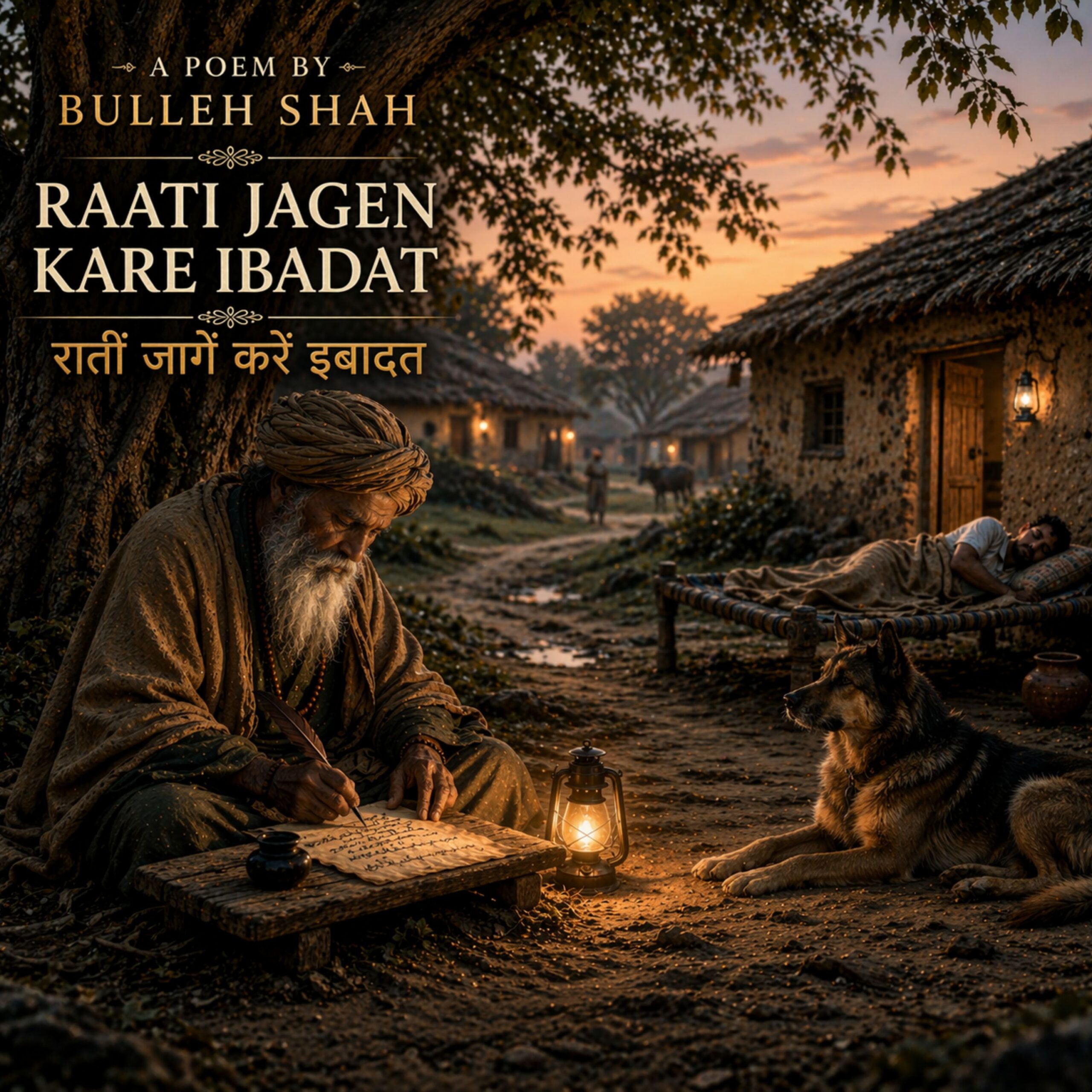
Raatin Jagen Karen Ibadat is Bulleh Shah at his most provocatively plainspoken — a kalam that holds up an ordinary street dog as a moral instructor and finds the seeker himself falling short of the comparison. It is not a gentle meditation; it is a rebuke, delivered with the kind of biting humor that runs through much of Bulleh Shah’s social critique.
The setup is deceptively simple: someone stays up at night performing ritual worship, and Bulleh Shah points to the dog outside, who also stays up all night — not out of piety, but out of unwavering loyalty to its master. What follows is a quiet demolition of the idea that visible religious performance is worth anything without the constancy, loyalty, and devotion that the dog offers freely and without complaint.
Lyrics
रातीं जागें करें इ’बादत रातीं जागण कुत्ते तैथों उते।
भौंकणों बंद मूल ना हुन्दे जा रूड़ी ते सुत्ते तैथों उते।
ख़सम आपने दा दर ना छड्डदे भावें वज्जन जुत्ते तैथों उते।
‘बुल्ल्हे’ शाह कोई रखत वेहाज लै नहीं ते बाज़ी लै गए कुत्ते तैथों उते।
Meaning of the Lyrics
The refrain sets up the whole comparison in a single stroke: you stay awake at night to perform your worship — but dogs stay awake at night too, and in that alone, they are already ahead of you. It’s a deliberately uncomfortable opening line, stripping away any pride the worshipper might take in their nightly devotion by pointing out that mere wakefulness proves nothing.
Bulleh Shah then pushes the comparison further. Even when a dog finally rests, sleeping on a heap of rubbish, it never stops barking — never stops keeping watch, never fully drops its guard, even in the humblest of circumstances. There’s no comfort or reward in it for the dog; its vigilance continues regardless.
The next line drives the point home with unmistakable clarity: dogs never leave the doorstep of their master, even if they are beaten and driven away from it. Loyalty, for the dog, is not conditional on treatment or reward — it simply persists. This is precisely the quality Bulleh Shah finds missing in so much human religious observance, which so often depends on comfort, recognition, or convenience.
The closing verse delivers the verdict outright: Bulleh Shah, he says, if you have no real devotion to hold onto, then know this — dogs have already won the contest against you. It is a sharp, almost comic humbling, but a serious one underneath: outward ritual, however impressive it looks, is worthless without the loyalty, humility, and constancy that even an ordinary street dog can offer without effort or expectation.
History & Devotion
This kalam sits squarely within Bulleh Shah’s broader project of puncturing hollow religiosity — a recurring theme across his poetry, in which he repeatedly turns to humble, overlooked figures and creatures to expose the emptiness of performed piety. Using a dog specifically as a moral example was, in the social and religious context of his time, a deliberately provocative choice, since dogs were often regarded with suspicion or disdain in the orthodox circles Bulleh Shah so frequently challenged.
That provocation is exactly the point. Bulleh Shah’s Sufi humanism consistently valued sincerity and steadfast love over visible ritual observance, and this kalam is one of his sharpest illustrations of that conviction — using biting, almost comic imagery to make a case that could not be dismissed as mere abstract theology. It remains one of his more widely quoted and performed kalams precisely because its central image is so immediate: anyone can picture the loyal dog at the door, and anyone can feel the sting of being asked whether they measure up to it.
Listen & Watch
▶️ Watch on YouTube | 🎧 Listen on Spotify
ਇਸ਼ਕ ਅੱਲਾਹ 🙏
More from EkOmkaar Musicals
- Bulleh Shah’s Creative Contributions — ਬੁੱਲ੍ਹੇ ਸ਼ਾਹ — Sufi Poet of Punjab | EkOmkaar Musicals
- The Life of Meera Bai — मीरा बाई का जीवन — Her Musical Contributions to Bhakti | EkOmkaar Musicals
- He Ri Main To Prem Diwani — हे री मैं तो प्रेम दिवानी — Meera Bai Bhajan | EkOmkaar Musicals
- Papiya Re Piv Ki Baani Na Bol — पपइया रे पिव की बाणि न बोल — Meera Bai Bhajan | EkOmkaar Musicals
- Hari Bin Kaun Gati Meri — हरि बिन कूण गति मेरी — Meera Bai Bhajan | EkOmkaar Musicals
- Muunh Aayi Baat Na Rehandi Hai — ਮੂੰਹ ਆਈ ਗੱਲ ਨਾ ਰਹਿੰਦੀ ਹੈ — Bulleh Shah Kalam | EkOmkaar Musicals
- Haaji Log Makke Nu Jaande — حاجی لوگ مکے نوں جاندے — Bulleh Shah Kalam
- Golden Hearts, Golden Jubilee — Mom & Dad, Forever Our Home (Lyrics & Meaning)