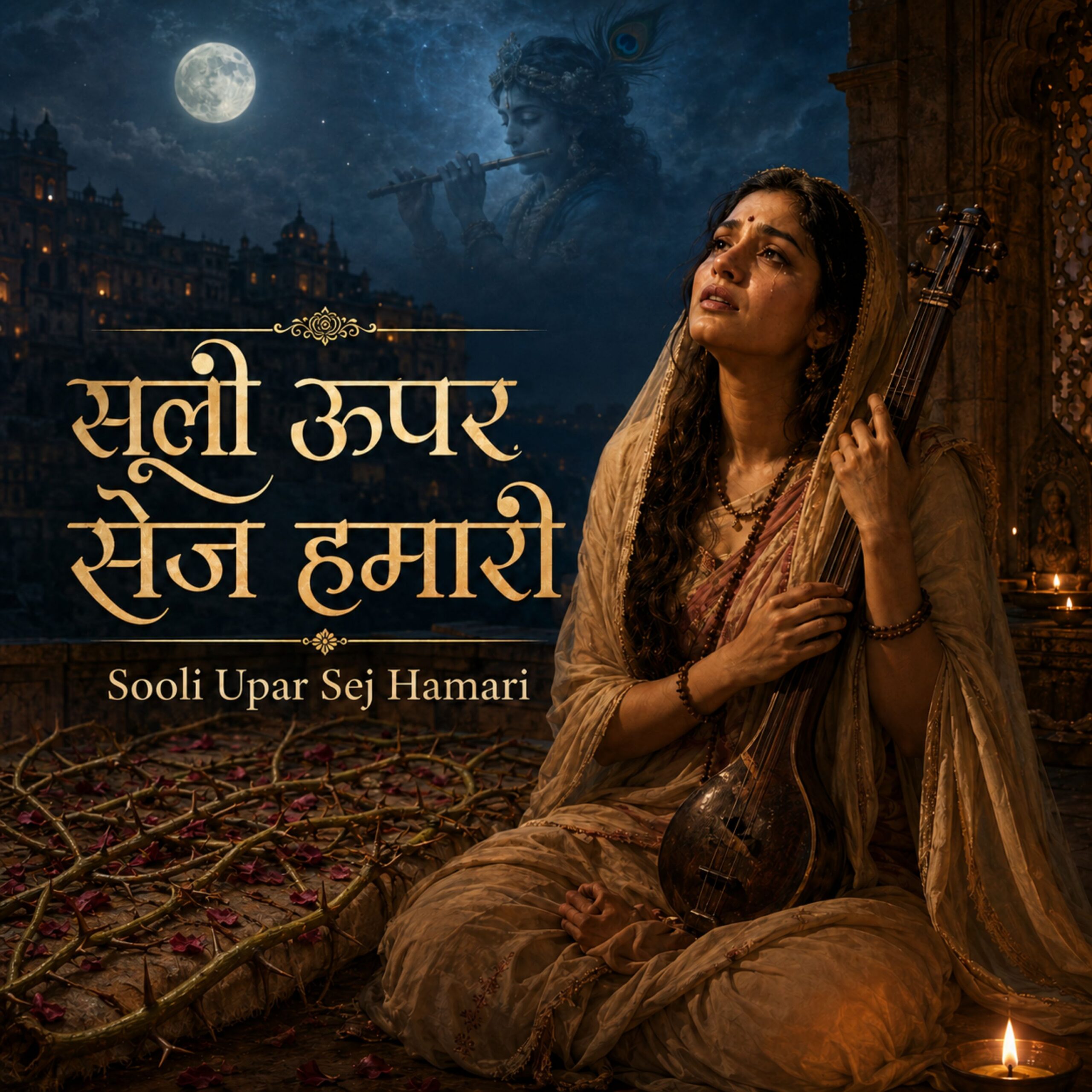

About This Song
He Ri Main To Prem Diwani is perhaps Meera Bai’s most direct self-portrait — a declaration, made to an unnamed female companion, that she has become “mad with love” and that no one around her can truly understand the pain this madness carries. Where some of Meera’s bhajans plead or bargain, this one simply states a fact about her condition and lets the images that follow prove it beyond argument.
The mood is one of complete, almost matter-of-fact surrender to an affliction Meera doesn’t want cured by ordinary means. She reaches for a series of comparisons — the wounded, the jeweler, the impossible bed — each one showing that her particular suffering can only be recognized by someone who has felt the same thing, or by the one who caused it. It is devotional music that treats divine love as something closer to sickness than comfort, and finds honesty in admitting exactly that.
Lyrics
हे री मैं तो प्रेम दिवानी, मेरा दरद न जाने कोय ।
सूली ऊपर सेज हमारी, किस बिध सोना होय ।
गगन मंडल पर सेज पिया की, किस बिध मिलना होय ॥
हे री मैं तो प्रेम दिवानी, मेरा दरद न जाने कोय ।घायल की गति घायल जानै, कि जिन लागी होय ।
जौहरी की गति जौहरी जाने, कि जिन लागी होय ॥
हे री मैं तो प्रेम दिवानी, मेरा दरद न जाने कोय ।दरद की मारी बन बन डोलूँ, वैद मिल्यो नहीं कोय ।
मीरां की प्रभु पीर मिटै, जब वैद सांवलया होय ॥
हे री मैं तो प्रेम दिवानी, मेरा दरद न जाने कोय ।
Meaning of the Lyrics
The opening line is Meera’s thesis for the whole bhajan: oh friend, I am mad with love — my pain is known to no one. It isn’t a complaint so much as a diagnosis, spoken almost with pride. She then reaches for her first impossible image: her bed is upon a gallows — how could anyone sleep there? — while her beloved’s bed rests in the heavens themselves — how could the two of them ever meet? The geography of the verse makes the point: her suffering and her longing exist on a scale ordinary life simply cannot hold.
The second verse turns to a pair of comparisons that were common in devotional poetry of her time: only the wounded truly understands what it is to be wounded, and only the jeweler understands the true state of a jewel. Meera is saying, in effect, that her love-sickness cannot be explained to someone standing outside it — it can only be recognized by one who has been struck the same way, or by the one skilled enough to see a heart’s true value from within.
The final verse turns from metaphor to plain confession. Struck by this pain, she wanders from forest to forest, and finds no physician who can treat her. The resolution arrives in the last line: Meera’s lord says her suffering will end only when the physician himself is Sanwariya — “the dark one,” her name for Krishna. The cure was never medicine; it was always him. Her illness and her devotion are, in the end, the same thing.
History & Devotion
This bhajan is among the most widely recorded and recognized of all songs attributed to Meera Bai, carried into the modern era through renditions by numerous classical and playback singers across generations — a testament to how completely its central image, love as a form of madness that only the beloved can cure, has resonated across centuries of devotional listening. As with much of Meera’s work, some later verses attached to popular recordings over the decades were added by other lyricists rather than Meera herself; the verses presented here reflect the composition as it is most widely attributed to her own hand.
The “vaid” or physician Meera invokes at the close — asking for a cure that can only come from Krishna as Sanwariya — situates this bhajan firmly within the Krishna bhakti tradition of divine love expressed through the language of illness and longing. It is a recurring device across bhakti poetry: the devotee’s suffering is not something to escape but something that, rightly understood, draws them closer to the very source of their pain and their healing at once.
Listen & Watch
▶️ Watch on YouTube | 🎧 Listen on Spotify
राधे राधे 🙏
More from EkOmkaar Musicals
- Papiya Re Piv Ki Baani Na Bol — पपइया रे पिव की बाणि न बोल — Meera Bai Bhajan | EkOmkaar Musicals
- Hari Bin Kaun Gati Meri — हरि बिन कूण गति मेरी — Meera Bai Bhajan | EkOmkaar Musicals
- Muunh Aayi Baat Na Rehandi Hai — ਮੂੰਹ ਆਈ ਗੱਲ ਨਾ ਰਹਿੰਦੀ ਹੈ — Bulleh Shah Kalam | EkOmkaar Musicals
- Haaji Log Makke Nu Jaande — حاجی لوگ مکے نوں جاندے — Bulleh Shah Kalam
- Golden Hearts, Golden Jubilee — Mom & Dad, Forever Our Home (Lyrics & Meaning)
- Bullah Ki Jaana Main Kaun — بلھا کی جاناں مَیں کون — Bulleh Shah Kalam