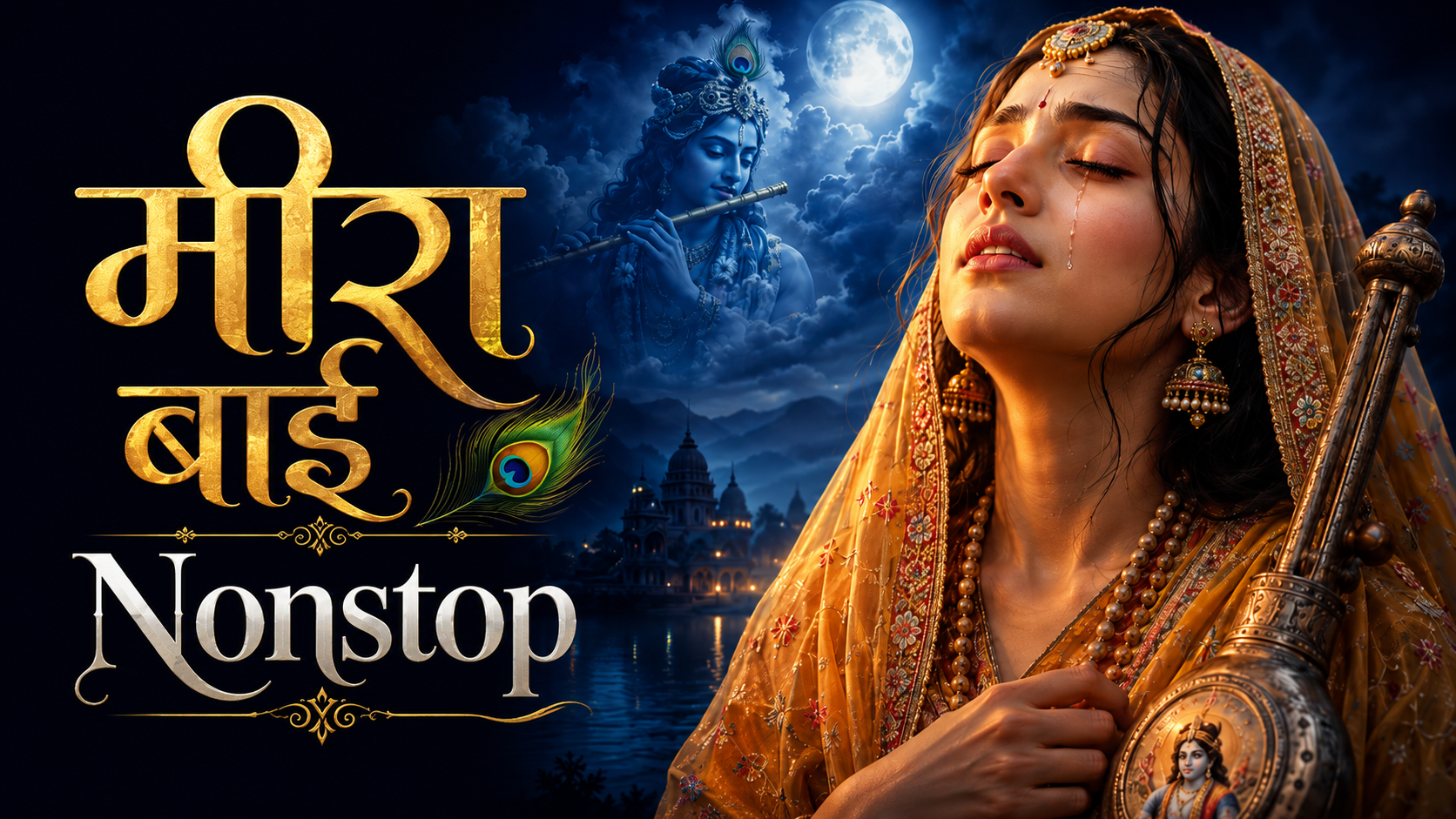
About This Song
प्यारे दरसन दीज्यो आये, तुम बिन रह्यो ना जाये. Beloved, come and let me see you — without you I cannot go on. Where Meera’s other padas declare and decide, this one only asks. It is a song of विरह: the ache of separation, the state bhakti poets treated not as an obstacle to love but as its most honest evidence.
She reaches for the plainest images available — a lotus with the water drained away, a night sky with no moon in it — and then stops explaining. What follows is simply a report on the body: no hunger by day, no sleep at night, and words that will not come. This EkOmkaar Musicals rendition gives it room, because the song asks for very little and means all of it.
Lyrics — प्यारे दरसन दीज्यो आय
टेक
प्यारे दरसन दीज्यो आये,
तुम बिन रह्यो ना जाये ॥
अंतरा
जल बिन कमल, चंद बिन रजनी ।
ऐसे तुम देख्यां बिन सजनी ।
आकुल व्याकुल फिरूँ रैन दिन,
बिरह कलेजो खाये ॥
अंतरा
दिवस न भूख, नींद नहिं रैना,
मुख सूँ कहत न आवै बैना ॥
In this rendition the टेक returns after each अंतरा, the way the pada is traditionally sung.
Meaning of the Lyrics
The refrain. Beloved, come — grant me the sight of you. Without you, I cannot remain.
First verse. A lotus with no water. A night with no moon. That, my friend, is what I am without the sight of you. Restless and undone I wander through the nights and days, and this separation is eating my heart out.
Second verse. No hunger comes by day, no sleep comes at night. My mouth is silent — the words will not rise to it.
Notice who she is speaking to in that first verse. सजनी is a woman friend, not Krishna. Meera turns aside mid-song to explain herself to a companion, the way grief actually behaves — addressing the absent one, then breaking off to tell whoever is nearby what the absence is like. The two images she reaches for are exact. A lotus out of water does not die at once; it stays intact and slowly loses everything that made it open. A moonless night is not dark for want of a sky — the sky is entirely there, and the one thing that gave it meaning is missing.
And then the verse that says the most by claiming the least. No hunger, no sleep, no speech. Meera, whose whole life was singing, reports that she cannot get a word out. In a tradition where longing is usually sung at full voice, the truest line is the one about not being able to sing.
History & Devotion
Meera Bai, born a Rathore princess around 1498 and married into the royal house of Mewar, was widowed young and refused the seclusion demanded of her. She sang publicly, danced before Krishna, kept company with wandering saints, and maintained that her true marriage was to Girdhar. The palace treated it as disgrace, and the traditions record attempts on her life that left her unharmed. She eventually left Mewar for Vrindavan and then Dwarka.
विरह — separation — is the central emotional state of Krishna bhakti, inherited from the gopis of Vrindavan who were left behind when Krishna went to Mathura and never returned. The bhakti poets made a striking claim about it: that longing for the divine is a higher state than comfortable possession of it, because the ache is proof that the love is real and not merely believed in. Meera’s viraha padas are the most personal in the tradition, and this is among the most stripped-down of them.
The language is her own Rajasthani rather than courtly Braj — रह्यो, देख्यां, रैना, बैना — the speech of the roads she walked. It is part of why her songs travelled through villages instead of staying in manuscripts, and why they are still sung by people who have never read a commentary.
There is one more thing worth saying about a song like this. Meera is describing the worst of it — sleepless, unable to eat, unable to speak — and she is describing it in a song. The pada itself is the evidence that the silence did not win. That is why these verses have comforted people in ordinary grief for five hundred years, whatever they believe about Krishna: someone once felt entirely unable to speak, and made this out of it anyway.
Listen & Watch
YouTube: Pyare Darsan Dijyo Aay — Meera Bai Bhajan | EkOmkaar Musicals
Spotify: Pyare Darsan Dijyo Aay on Spotify
Subscribe: EkOmkaar Musicals on YouTube
Part of the Meera Bai series — her life, her music, and all nine bhajans with lyrics and meaning. →
राधे राधे 🙏
More from EkOmkaar Musicals
- The Life of Meera Bai — मीरा बाई का जीवन — Her Musical Contributions to Bhakti | EkOmkaar Musicals
- Mere To Giridhar Gopal | मेरे तो गिरिधर गोपाल — Meera Bai Bhajan | Lyrics & Meaning
- Pyare Darsan Dijyo Aay | प्यारे दरसन दीज्यो आय — Meera Bai Bhajan | Lyrics & Meaning
- Chalan Vahi Desh | चालाँ वाही देस — Meera Bai Bhajan | Lyrics & Meaning
- Main Girdhar Ke Ghar Jaaun | मैं तो गिरधर के घर जाऊँ — Meera Bai Bhajan | Lyrics & Meaning
- Jai Jagdish Hare | जय जगदीश हरे — Dashavatar Bhajan | Lyrics & Meaning
- Dashavatara Stotra | प्रलय पयोधि जले — Jayadeva’s Gita Govinda | Lyrics & Meaning
- Guru Purnima 2026 — गुरु पूर्णिमा — Meaning, Story & the Song of the Guru | EkOmkaar Musicals