The Oldest of the Thousand-Name Hymns
Of the many Shiva Sahasranamas preserved in scripture, the one in the Mahabharata’s Anushasana Parva — Book 13, chapter 17 — is the oldest that survives. Most later Puranic versions are copies of it, or copies of copies, with local variations. When commentators discuss “the” Shiva Sahasranama without qualification, this is usually the text they mean.
It is also the version we have chosen for our own recitation. This page explains what it is, how it reached the epic, and why its framing is more interesting than it first appears. For the wider picture of how many versions exist and how they relate, see Shiva Sahasranama: History and the Different Versions.
How the Hymn Enters the Epic
The setting is the great instruction of the Anushasana Parva. Bhishma lies on the bed of arrows at Kurukshetra, dying at the hour of his own choosing, and Yudhishthira sits at his feet receiving the last teaching of his life.
Yudhishthira asks for the names of Maheshwara. And here the text does something unexpected. Bhishma — who has been expounding dharma to him since the Shanti Parva, and who will continue for another hundred chapters after this — declines. He says he is not competent to this subject; that to expound the names of the god of gods, only Krishna is able; that no man like himself can comprehend Bhava, and only Nārāyaṇa can. He turns to Krishna and addresses him as Vishnu, the one who pervades the whole universe, and asks him to answer in his place.
So the thousand names of Shiva, in the Mahabharata, are spoken by Krishna. And they are not his own composition either. He relays what the sage Upamanyu gave him, and Upamanyu received it from an older transmission still.
This layering matters. The hymn does not arrive as one man’s composition. It arrives already old, already handed down, with its own history attached — and it arrives through the mouth of the deity a sectarian reader would least expect.
A Note on the Order
Many printed editions and teaching traditions introduce this episode by saying that Yudhishthira, having just heard the thousand names of Vishnu from Bhishma, then asked for the thousand names of Shiva. It is a widely repeated framing and it has a long pedigree.
The chapter order does not support it. Yudhishthira’s request for Shiva’s names comes at Anushasana Parva 14, and Krishna’s recitation at chapter 17. The Vishnu Sahasranama comes far later in the same book — chapter 135 in the critical edition, chapter 149 in the Southern recension. On the page, Shiva’s thousand names come first by more than a hundred chapters.
We note the discrepancy rather than resolve it. The Anushasana Parva is a compiled book with a complicated manuscript history, and the received devotional sequence may preserve something the chapter numbering does not. But a reader who has been told one thing and then counts the chapters deserves to know why the two do not agree.
The Chain of Transmission
The text names its own lineage explicitly. The hymn is described as having first resided in Brahmā, who gave it to Indra; Indra to Mṛtyu, Death; Mṛtyu to the Rudras; and from the Rudras it came to the sage Tāṇḍi, who obtained it in the region of Brahmā as the fruit of severe austerity.
From Tāṇḍi it continues down to the scene at Kurukshetra: through the line of ṛṣis to Upamanyu, from Upamanyu to Krishna, and from Krishna to Yudhishthira. The chain that begins in Brahmā ends at the feet of a dying man on a battlefield.
It is worth sitting with. The transmission passes through Death before it reaches any human hand. A hymn about the one who withdraws all beings is carried by the power of withdrawal itself.
What the Hymn Says About Itself
Before the names begin, the text raises an objection to its own project. It asks who could possibly praise the Lord of the universe — the one whom even Brahmā and the gods do not know, whom the great ṛṣis fail to sing.
This is not modesty. It sets the terms for everything that follows. The thousand names are offered in full awareness that they are insufficient, and the offering is made anyway. That posture — approaching the inexpressible while admitting it is inexpressible — is the whole spirit of the hymn, and it is why the recitation traditionally closes with a request for forgiveness rather than a claim of merit.
What the Names Are Like
The Anushasana list has a particular character. It moves without warning between registers, and the movement is the point.
It gives physical description — the matted locks, the hide, the crest, the blue throat. It gives cosmic function — maker of the year, lord of the seizers, the standard of measure. It gives pure metaphysics — the self-existent, the hidden Self, the thousand-eyed. And then, in the middle of the metaphysics, it will place something startlingly concrete: the one concealed in the guise of a madman; the one present alike in the horse and the ass; the lord of the crossroads.
The sequence also holds the great narrative episodes in compressed form: the arrow loosed at the deer, the poison held at the throat, the river caught in the matted hair. A reciter who knows the stories finds the whole Purāṇic corpus folded into single words.
The Names That Are Not Shiva’s
There is one feature of this hymn that deserves more attention than it usually gets.
Among the thousand names of Shiva are Vishnu, Hari and Krishna. Not as passing allusions — as names, in the list, offered with the rest.
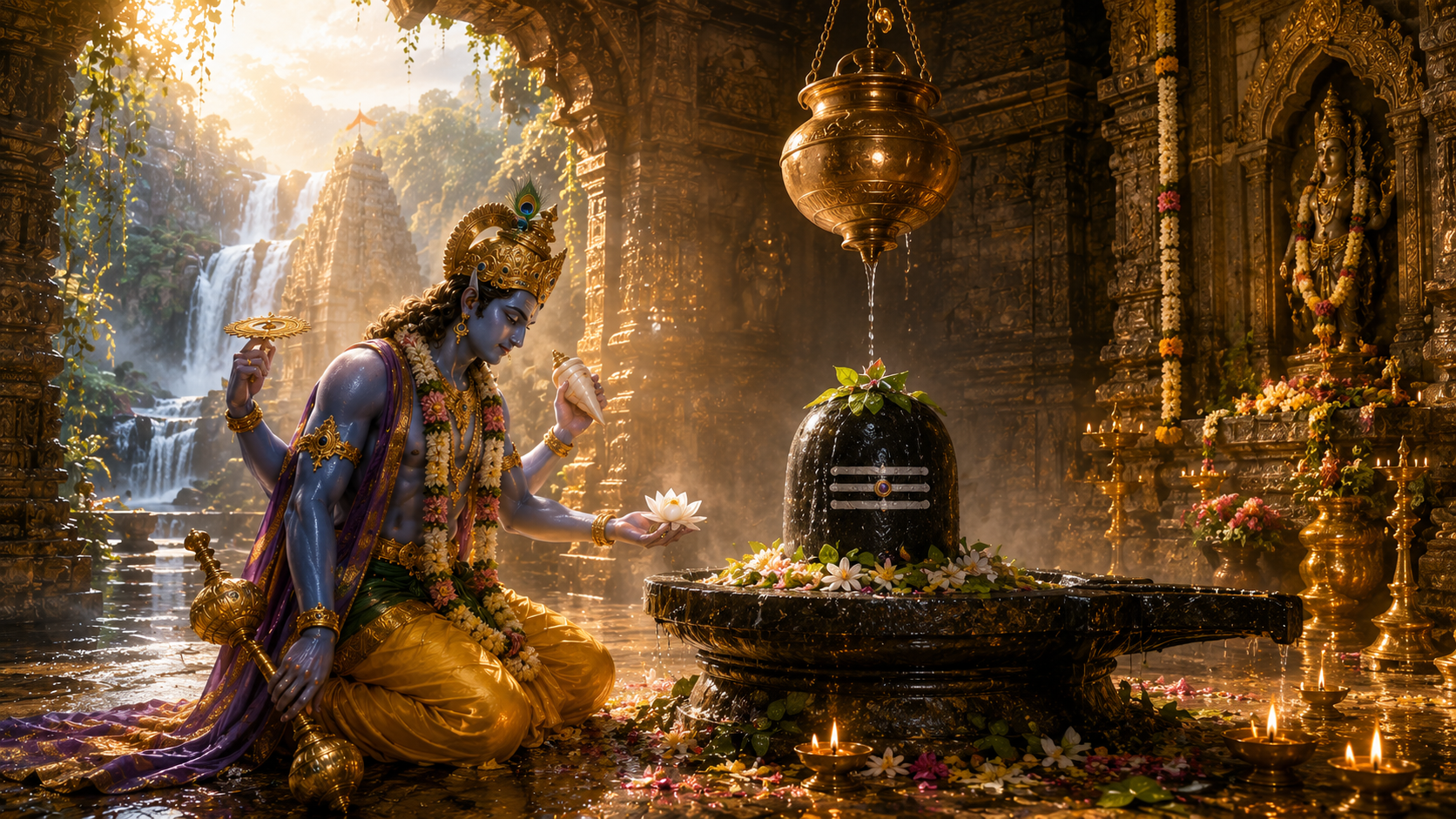
Set that beside the frame. Bhishma tells Yudhishthira that only Krishna can speak these names, and addresses him as Vishnu in the act of asking. Krishna then recites a hymn in which Shiva is called Vishnu, Hari and Krishna. The Vishnu Sahasranama returns the courtesy: among the thousand names of Vishnu stand Shiva, Sharva, Sthāṇu, Īshāna and Rudra.
The epic is not being careless, and it is not splitting the difference between two camps. It is saying something that both hymns say independently and that neither tradition invented later: at the level these names operate on, the distinction the reader brought to the text does not hold.
Editions and Variants
Two practical notes for anyone working with this text closely.
Critical versus traditional editions. The critical edition prepared at the Bhandarkar Oriental Research Institute reconstructs the earliest recoverable form of the epic and consequently carries fewer names than the familiar count. Traditional editions, including those from Gita Press, print the full set of verses that the commentarial tradition has historically accepted and worked with. Both are legitimate; they are answering different questions.
Commentary. The classical commentary on the Mahabharata by Nīlakaṇṭha covers this chapter and remains the standard reference for how the names have been understood within the tradition. Where a name admits two readings, it is generally Nīlakaṇṭha who preserves both.
Our Recitation
Our full recitation of the Anushasana Parva version is now published in the nāmāvalī form — each name in the dative, framed as ॐ … नमः — with the Devanagari on screen and imagery drawn from the names themselves rather than generic devotional stock. It is available on YouTube and on all streaming platforms.
The nāmāvalī form is the one used for archana: one bilva leaf, one flower or one drop of water offered at each name. It is made to be used rather than only listened to, which is why we chose it over the stotra form for a recitation released during Shravan.
The recitation closes, as tradition requires, with a kṣamā-prārthanā — a prayer for the forgiveness of errors in pronunciation, in pitch accent, and in the division of words. This is not a formality. A Sahasranama is a Sanskrit text of extraordinary density, containing rare compounds and archaic forms, and no reciter completes it without fault. The closing verse is the one every tradition shares:
यदक्षरपदभ्रष्टं मात्राहीनं तु यद्भवेत् ।
तत्सर्वं क्षम्यतां देव प्रसीद परमेश्वर ॥Whatever syllables and words have been dropped, whatever measures have fallen short — forgive it all, O Lord; be gracious, Supreme Lord.
Watch the full recitation on YouTube →
Listen on Spotify →
Also on Apple Music and all major streaming platforms.
Continue
- Shiva Sahasranamavali: Names and Meanings, One Line Each — the full glossary, name by name, with the recitation form
- Shiva Sahasranama: History and the Different Versions — every source, and which are original compositions
ॐ नमः शिवाय
More from EkOmkaar Musicals
- The Mahabharata Version of the Shiva Sahasranama | EkOmkaar Musicals
- Shiva Sahasranama: History and the Different Versions | EkOmkaar Musicals
- Shiva Sahasranamavali: Names and Meanings, One Line Each (Part 1) | EkOmkaar Musicals
- Main Paiya Hai | ਮੈਂ ਪਾਇਆ ਹੈ — Bulleh Shah Kafi | Lyrics & Meaning
- Ni Saiyon Main Gayi Gavachi | ਨੀ ਸਈਓ ਮੈਂ ਗਈ ਗਵਾਚੀ — Bulleh Shah Kafi | Lyrics & Meaning
- Main Aape Ranjha Hoi | ਮੈਂ ਆਪੇ ਰਾਂਝਾ ਹੋਈ — Bulleh Shah Kafi | Lyrics & Meaning
- Saade Val Mukhda Mod | ਸਾਡੇ ਵੱਲ ਮੁਖੜਾ ਮੋੜ — Bulleh Shah Kafi | Lyrics & Meaning
- Ranjha Jogira Ban Aaya | ਰਾਂਝਾ ਜੋਗੀੜਾ ਬਣ ਆਇਆ — Bulleh Shah Kafi | Lyrics & Meaning