Why There Is More Than One
Anyone who goes looking for the Shiva Sahasranama quickly discovers a problem. Two printed books will give different names in the same position. A recording will skip a line another recording includes. A commentary will gloss a name that does not appear in the text you are holding.
This is not corruption or carelessness. There are genuinely several distinct Shiva Sahasranamas, composed at different times, preserved by different communities, and copied into scripture after scripture with variations. Understanding which one you have in your hands changes how you read it.
Sources, Versions, Compositions
Three different numbers circulate, and they are counting three different things. Keeping them apart resolves most of the confusion.
Sources — the scriptures in which a Shiva Sahasranama appears at all. There are roughly eighteen. Most are copies of an earlier text with local variation.
Versions — texts that differ enough from one another to be worth collating separately. Comparative scholarship generally identifies around eight.
Independent compositions — texts not derived from any of the others. There are four.
So a book that says “eighteen” and a book that says “eight” are both right, and neither contradicts the four described below.
The Older Practice Behind the Hymn
The thousand-name hymn did not appear from nowhere. Its ancestor is the Vedic practice of nāma-vidyā — approaching the ultimate through an accumulation of names rather than a single definition. The Śatarudrīya, the great Rudra hymn of the Yajur Veda that is recited today as the Śrī Rudram, already gathers roughly a hundred names of Rudra and addresses him through all of them at once.
The logic is the same at a hundred names or a thousand: no single name is adequate, so the reciter offers all of them and lets the accumulation do what no definition could. The Sahasranama form is the Vedic technique carried to its limit.
The Four Independent Compositions
1. Mahabharata, Anushasana Parva
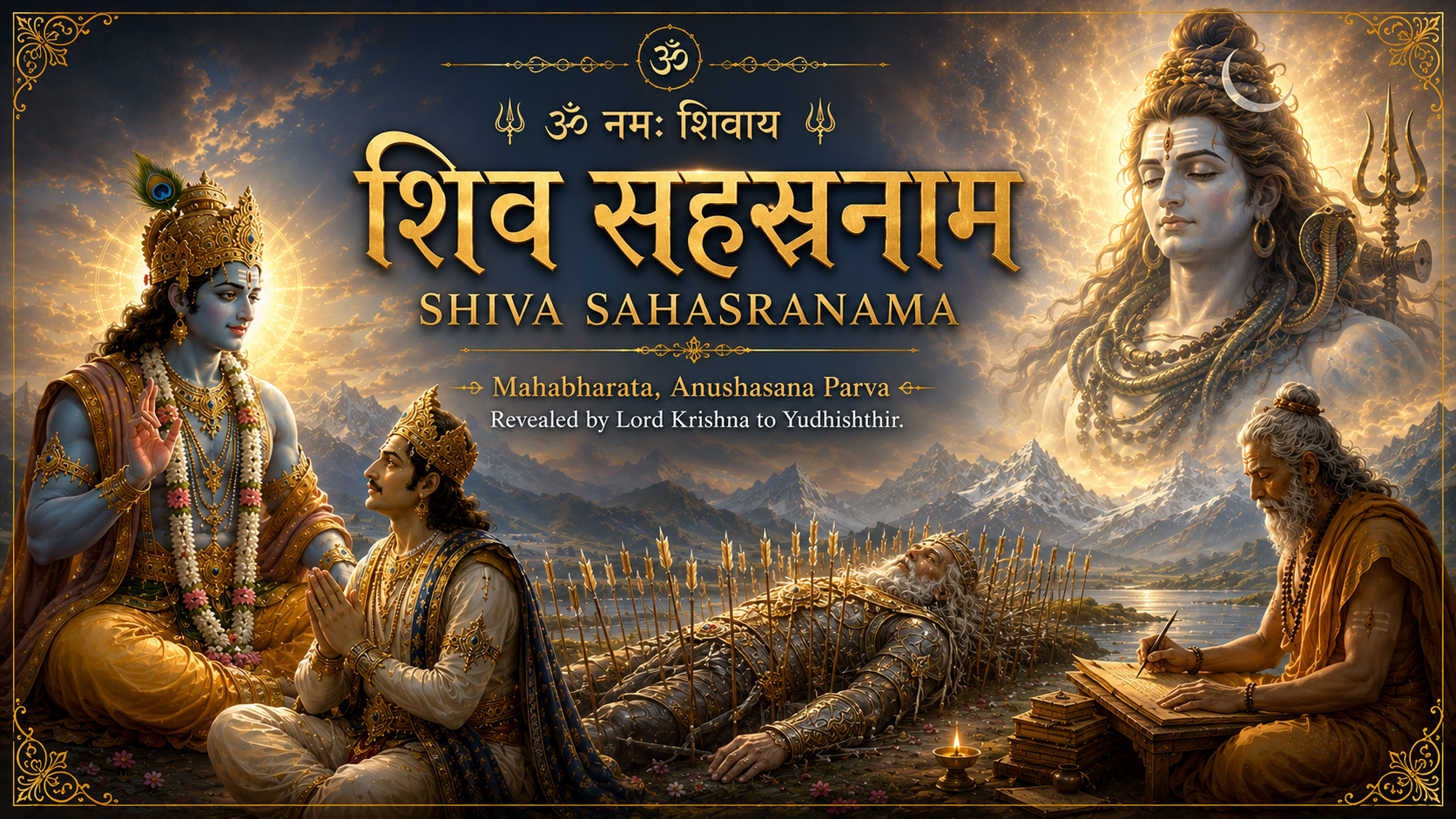
Book 13, chapter 17 of the Mahabharata. This is the oldest surviving Shiva Sahasranama and the one most commentators treat as the standard. Notably, it is not spoken by Bhishma: he declines the subject and asks Krishna to answer in his place, and Krishna recites what he received from the sage Upamanyu. It is the version we use in our own recitation — described in detail in The Mahabharata Version of the Shiva Sahasranama.
2. Mahabharata, Shanti Parva
A second Sahasranama is also reported in the Mahabharata, in the Shanti Parva. It is generally regarded as later than the Anushasana Parva version and as having entered the epic after the Anushasana text was already established. It is not carried in the standard critical edition.
3. Shiva Purana, Kotirudra Samhita
Book IV of the Shiva Purana carries an original composition, not derived from either Mahabharata text. Here the hymn is spoken by Vishnu in praise of Shiva. Its independence makes it the most valuable comparison text for anyone studying the tradition seriously.
4. Rudrayamala Tantra
A fourth independent version survives in the Rudrayamala Tantra, later copied into the Shiva Rahasya Itihasa. Its vocabulary and emphasis are noticeably tantric rather than epic.
The Full List of Sources
Beyond the four independent compositions, the Sahasranama appears — usually as a copy of one of the Mahabharata versions, with local variations — across a wide body of scripture:
- Mahabharata, Anushasana Parva
- Mahabharata, Shanti Parva
- Linga Purana, version 1
- Linga Purana, version 2
- Shiva Purana, Kotirudra Samhita
- Vayu Purana
- Brahmanda Purana
- Mahabhagavata Upapurana
- Padma Purana
- Skanda Purana
- Vamana Purana
- Markandeya Purana
- Saura Purana
- Bhairava Tantra
- Bhringiridi Samhita
- Rudrayamala Tantra
- Shiva Rahasya Itihasa
- Akasa Kalpa Tantra
The Linga Purana deserves particular mention because it is the version most often encountered alongside the Mahabharata text. Its first version follows the Anushasana Parva closely. Its second shares some passages with the first but also draws on other sources, making it a genuinely mixed text.
Each Hymn Contains the Other
One feature of this literature is easy to miss and hard to unsee once noticed.
Among the thousand names of Shiva in the Anushasana Parva stand Vishnu, Hari and Krishna. Among the thousand names of Vishnu, later in the same book, stand Shiva, Sharva, Sthāṇu, Īshāna and Rudra.
Neither list is borrowing from the other as a gesture of politeness. Each is doing what a Sahasranama does — exhausting the available vocabulary for the ultimate — and finding that the vocabulary will not stay inside sectarian boundaries. The two hymns arrive at the same conclusion from opposite directions.
Which Version Should You Recite?
There is no wrong answer, and the traditional position is that all of them reach the same place. But three practical considerations are worth knowing:
If you want the oldest and most commented-upon text, use the Mahabharata Anushasana Parva version. It has the deepest commentarial tradition behind it, including Nīlakaṇṭha’s classical commentary on the epic.
If your teacher or lineage has given you a specific text, use that one. Sahasranama recitation is transmitted, not selected, and the version your tradition preserves is the correct version for you.
If you are comparing printed editions and finding discrepancies, check whether you are looking at a critical edition or a traditional one. Critical editions reconstruct the earliest recoverable text and consequently carry fewer names; traditional editions such as those from Gita Press print the full set of verses that the commentators have historically accepted and worked with. Neither is wrong — they are answering different questions.
Stotra or Nāmāvalī?
A second distinction cuts across all of the above, and it confuses more readers than the version question does.
The stotra form gives the names as they stand in the verse, in metre, strung together: sthiraḥ sthāṇuḥ prabhur bhīmaḥ…
The nāmāvalī form puts each name in the dative and frames it: ॐ स्थिराय नमः. This is the form used for archana, where an offering is made at each name.
They are the same hymn in different grammatical dress. If you are following a printed stotra while listening to a nāmāvalī recording, the words will seem not to match — but nothing is missing. Our glossary gives both forms side by side for exactly this reason.
Why the Count Is Not Exactly One Thousand
Most printed Shiva Sahasranamas contain slightly more than a thousand names, commonly cited as 1008. Some contain rather fewer. Several factors produce this:
- Compound splitting. A single Sanskrit compound can be read as one name or as two, and different commentators split differently. This alone shifts the count by dozens.
- Deliberate repetition. Certain names recur in the hymn, in different company each time. Durvāsas and Hara both appear more than once. Whether a repetition counts once or twice is an editorial decision.
- Auspicious rounding. The number 1008 carries its own significance in the tradition, and editions have sometimes been arranged toward it.
None of this affects recitation. The hymn is not an inventory to be audited; the number in the title indicates completeness, not a count to be verified.
Hearing the Anushasana Version
Our own recitation follows the Mahabharata Anushasana Parva text in the nāmāvalī form, with the Devanagari on screen:
Watch the full recitation on YouTube →
Listen on Spotify →
Also on Apple Music and all major streaming platforms.
Reading the Names Themselves
If you want to work through the names one at a time with their meanings, our ongoing glossary gives each name in Devanagari, in transliteration, in the recitation form, and in a single line of plain English:
- Shiva Sahasranamavali: Names and Meanings, One Line Each
- The Mahabharata Version of the Shiva Sahasranama
ॐ नमः शिवाय
More from EkOmkaar Musicals
- The Mahabharata Version of the Shiva Sahasranama | EkOmkaar Musicals
- Shiva Sahasranama: History and the Different Versions | EkOmkaar Musicals
- Shiva Sahasranamavali: Names and Meanings, One Line Each (Part 1) | EkOmkaar Musicals
- Main Paiya Hai | ਮੈਂ ਪਾਇਆ ਹੈ — Bulleh Shah Kafi | Lyrics & Meaning
- Ni Saiyon Main Gayi Gavachi | ਨੀ ਸਈਓ ਮੈਂ ਗਈ ਗਵਾਚੀ — Bulleh Shah Kafi | Lyrics & Meaning
- Main Aape Ranjha Hoi | ਮੈਂ ਆਪੇ ਰਾਂਝਾ ਹੋਈ — Bulleh Shah Kafi | Lyrics & Meaning
- Saade Val Mukhda Mod | ਸਾਡੇ ਵੱਲ ਮੁਖੜਾ ਮੋੜ — Bulleh Shah Kafi | Lyrics & Meaning
- Ranjha Jogira Ban Aaya | ਰਾਂਝਾ ਜੋਗੀੜਾ ਬਣ ਆਇਆ — Bulleh Shah Kafi | Lyrics & Meaning