A song that holds ten stories
Some songs are about one thing. This one is about ten.
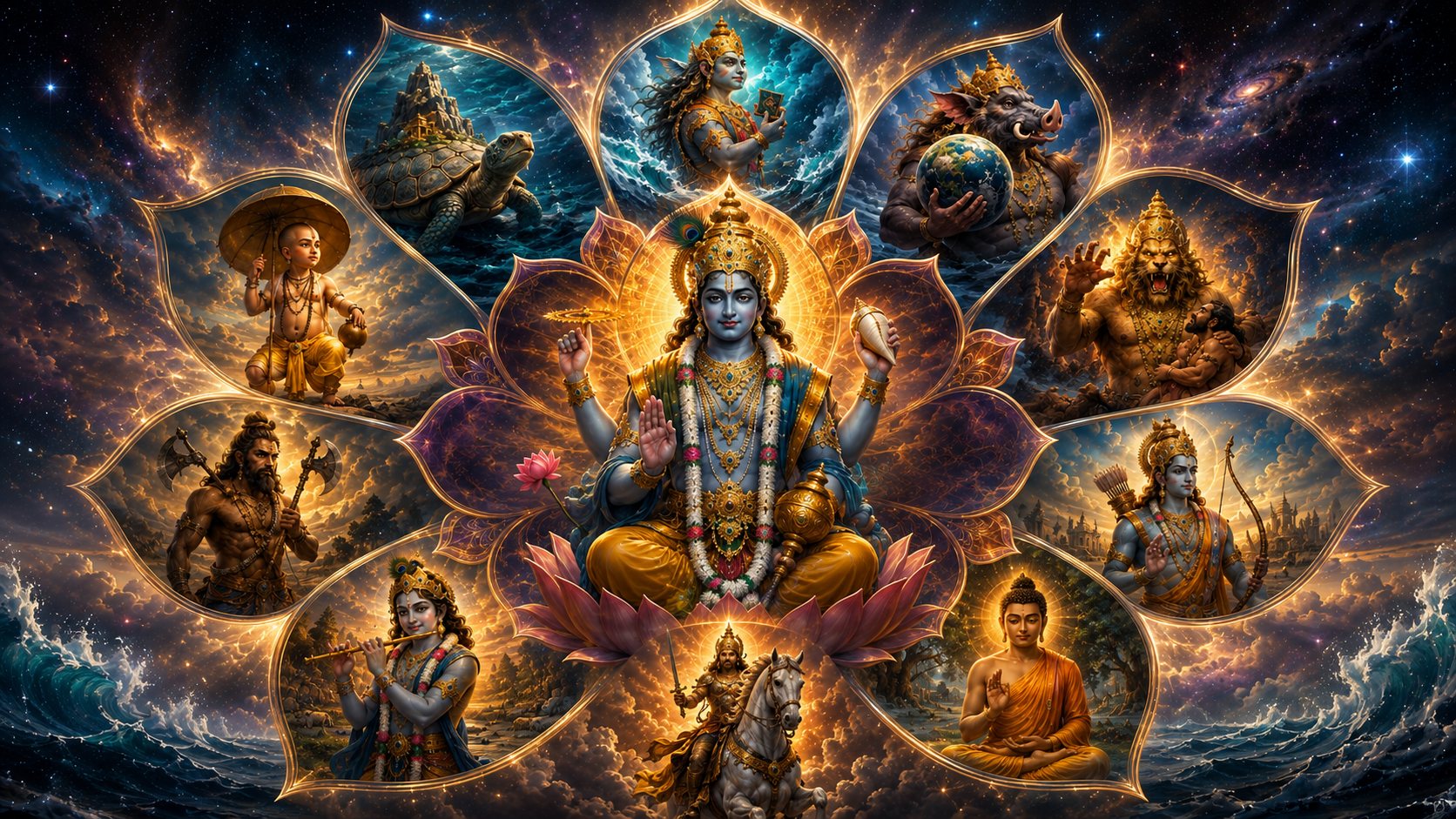
Pralaya Payodhi Jale is a Sanskrit song that is more than 800 years old. In just eleven short verses, it walks through all ten avatars of Lord Vishnu — a fish, a turtle, a boar, a lion-man, a small boy, and five more. Each verse is like a tiny window. You look through it, and you see a whole story.
An avatar means a form that God takes to come down to earth. The old belief is simple: whenever the world is in trouble, help arrives. Sometimes it arrives as something huge. Sometimes it arrives as something very small. The song shows you both.
We are happy to share our new recording of this beautiful old song. Below you will find the words, and next to them, what they mean in plain English.
Who wrote it?
The poet’s name was Jayadeva. He lived in the 1100s in eastern India, in the land we now call Odisha and Bengal. He wrote a famous book of songs called the Geet Govinda, which means “the song of Govinda.” Govinda is another name for Krishna.
Jayadeva did not write his poems to be read quietly. He wrote them to be sung. He even marked which tune and which rhythm each song should use. That was unusual for his time, and it is one reason people still sing his words today, 800 years later, in temples from Puri to Kerala.
This particular song is the very first one in the Geet Govinda. It is often called the Dashavatara Stotra — dasha means ten, avatara means form, and stotra means a song of praise.
The line that repeats
At the end of every verse, you will hear the same words come back:
Keshava dhruta-___-rupa, jaya jagadisha hare
Here is what it means:
- Keshava — a name for Vishnu, meaning the one with beautiful hair
- dhruta — took on, or held
- rupa — form or shape
- jaya — victory to you
- jagadisha — Lord of the whole world
- hare — O Hari (another name for Vishnu)
So the line means: “O Keshava, you who took the form of a fish — victory to you, Lord of the world, O Hari!” Only the middle word changes each time, as the form changes. That repeating line is what makes the song so easy to join in on, even if you do not speak Sanskrit.
In our version, you will also hear the words Gopala Krishna woven in between the lines. Gopala means “the one who cares for the cows.” It is a soft, loving name for Krishna, and it fits this song like a second heartbeat.
The ten forms, one by one
1. Matsya Avtaar— the fish
Pralaya-payodhi-jale dhrutavan asi vedam
Vihita-vahitra-charitram akhedam
Keshava dhruta-mina-sharira, jaya jagadisha hare
Meaning: A great flood covered the whole world. The holy books, the Vedas, were about to be lost forever in the water. So Vishnu became a fish and carried them to safety, the way a boat carries people across a river. And he did it without getting tired at all.
This is the very first line of the song, and it is where the name comes from. Pralaya means the great flood at the end of an age. Payodhi means ocean. Jale means in the water.
2. Kacchap Avtaar— the tortoise
Kshitir ati-vipulatare tava tishthati prishthe
Dharani-dharana-kina-chakra-garishthe
Keshava dhruta-kachchhapa-rupa, jaya jagadisha hare
Meaning: The gods and the demons wanted to churn the ocean, and they used a mountain as their churning stick. But the mountain began to sink. So Vishnu became a giant turtle and let the mountain rest on his back. The poet notices something touching here: the shell has a round mark on it, like a scar, from carrying so much weight for so long.
3. Varaha Avtaar— the boar
Vasati dashana-shikhare dharani tava lagna
Shashini kalanka-kaleva nimagna
Keshava dhruta-sukara-rupa, jaya jagadisha hare
Meaning: The earth had sunk down into the water. Vishnu became a wild boar, dived deep, and lifted the whole earth up on the tip of his tusk. The poet says the earth looked like the dark spot you can see on the moon — small, resting there, safe.
4. Narasimha Avtaar— the lion-man
Tava kara-kamala-vare nakham adbhuta-shringam
Dalita-hiranyakashipu-tanu-bhringam
Keshava dhruta-nara-hari-rupa, jaya jagadisha hare
Meaning: A cruel king named Hiranyakashipu had a magic blessing. He could not be killed by a human or an animal, indoors or outdoors, by day or by night, by any weapon. So Vishnu came as something in between everything — half man, half lion — at dusk, in a doorway, and used no weapon at all. Just his nails. The poet calls the nails “wonderful claws,” sharp as horns.
5. Vamana Avtaar— the small boy
Chhalayasi vikramane balim adbhuta-vamana
Pada-nakha-nira-janita-jana-pavana
Keshava dhruta-vamana-rupa, jaya jagadisha hare
Meaning: King Bali had taken over the three worlds. Vishnu came to him as a short young boy and asked for a very small gift — just as much land as he could cover in three steps. Bali laughed and agreed. Then the boy grew and grew, until two steps covered everything there was. The story says that when his foot reached the top of the sky, water washed over his toenail, and that water became the holy river Ganga, which still cleans people today.
6. Parashurama Avtaar— the one with the axe
Kshatriya-rudhira-maye jagad apagata-papam
Snapayasi payasi shamita-bhava-tapam
Keshava dhruta-bhrigupati-rupa, jaya jagadisha hare
Meaning: This is the fiercest verse in the song. Some kings had become greedy and were hurting their own people. Vishnu was born as Parashurama, from the family of the sage Bhrigu, and fought them. The poet uses a strong picture: the world was washed clean, and its fever cooled. It is a hard image, but the idea underneath is gentle — when power turns cruel, it does not get to last forever.
7. Rama Avtaar— the prince of Ayodhya
Vitarasi dikshu rane dik-pati-kamaniyam
Dasha-mukha-mauli-balim ramaniyam
Keshava dhruta-raghupati-rupa, jaya jagadisha hare
Meaning: Ravana, the ten-headed king of Lanka, had carried away Rama’s wife Sita. In the great battle, Rama defeated him. The poet imagines the ten heads being offered as gifts to the guardians who watch over the ten directions of the world — north, south, east, west, and all the ones in between. Raghupati means the lord of the Raghu family, which is Rama’s family name.
8. Krishna Avtaar — the one with the flute
Vahasi vapushi vishade vasanam jaladabham
Hala-hati-bhiti-milita-yamunabham
Keshava dhruta-haladhara-rupa, jaya jagadisha hare
Meaning: Krishna Avtaar gave bhagvad Geeta and taught us the way to life. Balarama was Krishna’s elder brother. He was fair-skinned and wore a dark blue robe, so the poet says he looked like a bright body wrapped in a rain cloud. Balarama carried a plough — a farmer’s tool, not a sword. There is a lovely story here: he once used the plough to pull the river Yamuna closer, and the poet says the blue of his robe is the frightened river hurrying to come near.
9. Buddha Avtaar— the compassionate one
Nindasi yajna-vidher ahaha shruti-jatam
Sadaya-hridaya darshita-pashu-ghatam
Keshava dhruta-buddha-sharira, jaya jagadisha hare
Meaning: In this form, Vishnu did not fight anyone. He simply looked at the animals being killed in the old sacrifice rituals, and his heart hurt. So he spoke against those rules. The words sadaya-hridaya mean “a heart full of kindness.” This verse is famous because it shows a very different kind of strength — the courage to say that something everyone accepts is still wrong.
10. Kalki Avtaar— the one still to come
Mlechchha-nivaha-nidhane kalayasi karavalam
Dhumaketum iva kim api karalam
Keshava dhruta-kalki-sharira, jaya jagadisha hare
Meaning: This is the only avatar that has not happened yet. The old stories say that at the end of this age, when the world has grown very unfair, Vishnu will come riding a white horse, carrying a sword that flashes across the sky like a comet, to set things right and begin a fresh age. It is the song’s way of saying: the story is not finished.
The last verse — the poet signs his name
Shri-jayadeva-kaver idam uditam udaram
Shrinu sukhadam shubhadam bhava-saram
Keshava dhruta-dasha-vidha-rupa, jaya jagadisha hare
Meaning: Jayadeva ends by putting his own name into the poem, the way an artist signs a painting. He tells the listener: please listen to this song. It brings happiness, it brings good things, and it holds the heart of what life is about. And then the refrain comes one last time — this time not for one form, but for all ten together.
Why this song still works
Here is what we love about it. The song never explains the stories. It just points at them.
One line about a turtle’s shell. One line about a spot on the moon. One line about a nail sharp as a horn. Jayadeva trusted that you already knew the tales, so he gave you only the picture — the single most beautiful detail from each one. It is the difference between someone telling you the whole story and someone showing you one photograph from it.
That is also why it is so good to sing. You do not need to follow a plot. You just move through ten images, with the same warm line bringing you home at the end of each one.
And there is one more thing worth noticing. The ten forms go from a fish, to a turtle, to a boar, to a half-lion, to a small human, to a full human, and finally to something still ahead of us. Whether or not you read it that way on purpose, it is a lovely shape for a song: life beginning in water, and slowly walking out onto the land.
When people sing it
This song belongs to Vishnu, and so it turns up on the days that belong to Vishnu.
Ekadashi is the eleventh day of each half of the moon’s cycle. It comes twice a month, and many people keep a fast on that day and spend it thinking about Vishnu. The Dashavatara Stotra is a lovely thing to keep playing through an Ekadashi — it is short, it repeats, and it gives your mind ten pictures to rest on instead of ten worries. The next ones are Kamika Ekadashi on Sunday, 9 August 2026, and Putrada Ekadashi on 23–24 August.
Then comes the big one. Krishna Janmashtami falls on Friday, 4 September 2026 (and on 5 September for many Vaishnava temples, including ISKCON). It celebrates the night Krishna was born in a prison cell in Mathura. Many families stay awake until midnight, singing.
There is a nice reason this particular song fits that night. Jayadeva wrote the whole Geet Govinda about Krishna — and yet he opened it not with Krishna’s story, but with all ten forms at once. It is his way of saying: the boy born at midnight in Mathura is the same one who was the fish, and the turtle, and the boar, and the lion. Singing this on Janmashtami is like looking at a whole family album before you meet the person.
One more date worth marking: Parivartini Ekadashi on 22 September 2026 is connected to the Vamana avatar. That is verse five of this song — the small boy who asked for three steps of land.
How to listen
You do not need to know Sanskrit to enjoy this. Try it this way:
- Listen once with your eyes closed. Just let the sound move.
- Listen again and follow only the last line of each verse. You will start to catch jaya jagadisha hare coming back around.
- Listen a third time with the meanings above open beside you, and watch the ten pictures appear one by one.
By the third time, most people find they are singing along without meaning to. That is exactly what Jayadeva was hoping for, 800 years ago.
And if you would like to sing these same ten stories in words you already understand, we have made a Hindi version of this song too: Keshav Madhav Gopal Krishna (listen on Spotify).
Thank you for listening with us. 🙏
🎧 Listen to Pralaya Payodhi Jale on Spotify
Pralaya Payodhi Jale (Dashavatara Stotra) — from the Geet Govinda of Jayadeva. Available now on our YouTube channel and on all streaming platforms through EkOmkaar Musicals.
More from EkOmkaar Musicals
- The Mahabharata Version of the Shiva Sahasranama | EkOmkaar Musicals
- Shiva Sahasranama: History and the Different Versions | EkOmkaar Musicals
- Shiva Sahasranamavali: Names and Meanings, One Line Each (Part 1) | EkOmkaar Musicals
- Main Paiya Hai | ਮੈਂ ਪਾਇਆ ਹੈ — Bulleh Shah Kafi | Lyrics & Meaning
- Ni Saiyon Main Gayi Gavachi | ਨੀ ਸਈਓ ਮੈਂ ਗਈ ਗਵਾਚੀ — Bulleh Shah Kafi | Lyrics & Meaning
- Main Aape Ranjha Hoi | ਮੈਂ ਆਪੇ ਰਾਂਝਾ ਹੋਈ — Bulleh Shah Kafi | Lyrics & Meaning
- Saade Val Mukhda Mod | ਸਾਡੇ ਵੱਲ ਮੁਖੜਾ ਮੋੜ — Bulleh Shah Kafi | Lyrics & Meaning
- Ranjha Jogira Ban Aaya | ਰਾਂਝਾ ਜੋਗੀੜਾ ਬਣ ਆਇਆ — Bulleh Shah Kafi | Lyrics & Meaning