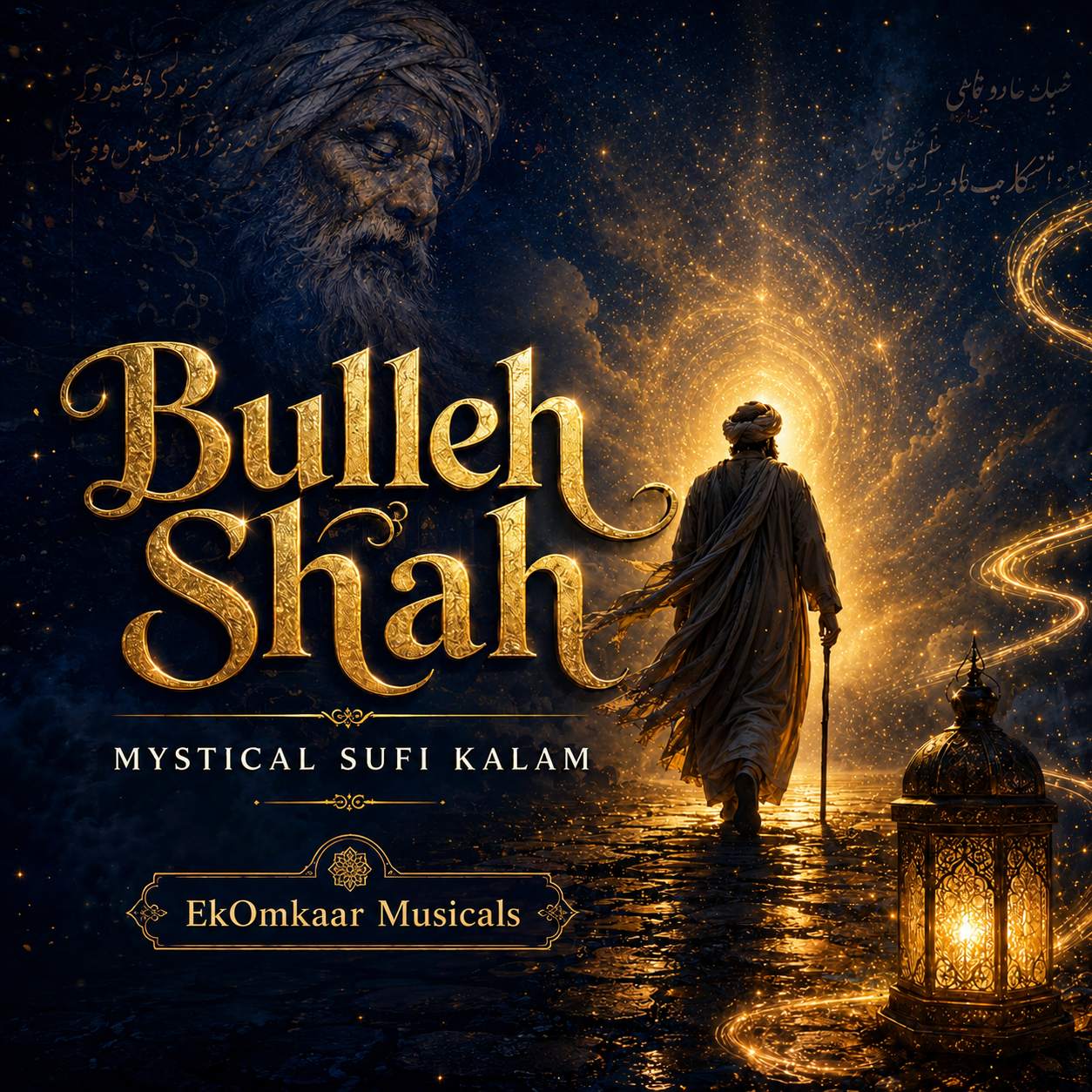
Who Was Bulleh Shah?
Bulleh Shah — born Sayyid Abdullah Shah Qadri around 1680, in Uch in present-day Punjab — is remembered as one of the greatest poets the Punjabi language has produced, and is often called the “Father of Punjabi Enlightenment.” He lived during a turbulent period in Punjab’s history, as Mughal authority declined and new powers rose in its place, and his poetry speaks directly to the human cost of that upheaval even as it reaches for something well beyond politics.
Born into a family of religious scholars — his father was versed in Arabic, Persian, and the Quran — Bulleh Shah received a traditional religious education before choosing a path that would put him at odds with the orthodoxy he was raised in. He spent most of his life in Kasur, where he died at around 77 years of age, and where his tomb remains a site of pilgrimage to this day.
Life & Spiritual Journey
The defining relationship of Bulleh Shah’s life was with his spiritual guide, Shah Inayat Qadiri, a respected Sufi teacher of Lahore. In a step that scandalized his own high-status Sayyid family, Bulleh Shah chose to follow Shah Inayat despite his teacher belonging to a caste traditionally considered far lower in social standing — an act of devotion that was, in itself, a quiet rebellion against the caste hierarchy of his time. That relationship shaped nearly everything that followed in his poetry, which returns again and again to his teacher as the very image of the Beloved.
Bulleh Shah’s outspoken rejection of empty ritual and religious orthodoxy earned him real hostility from some of the religious authorities of his day. According to tradition, when he died he was declared a nonbeliever by local clerics who refused to permit prayers for him in the community graveyard, and he was buried on the outskirts of Kasur instead — only for a respected religious figure to step forward and lead his funeral prayers regardless. The dargah that today stands over his tomb, drawing large numbers of visitors every year, stands as a striking reversal of that early rejection.
Literary & Musical Contributions
Bulleh Shah wrote almost entirely in Punjabi rather than the more scholarly Persian or Arabic available to him, deliberately choosing the language of ordinary people to carry his most difficult spiritual ideas. His primary form was the kafi — a Punjabi and Sindhi verse structure built around a repeating refrain — of which roughly 150 are attributed to him, alongside dozens of other poetic compositions. That refrain structure made his kafis naturally suited to music, and they have been set to song by performers ranging from anonymous street singers to some of the most celebrated Sufi vocalists of the modern era, including Nusrat Fateh Ali Khan and Abida Parveen.
Philosophically, his poetry is closely associated with the Sufi concept of Wahdat-ul-Wujood — the idea that all existence is a single, unified manifestation of the divine — expressed through recurring imagery of Heer and Ranjha, the lovers of Punjabi folklore, whom Bulleh Shah repurposed as symbols of the soul’s longing for union with God. Running alongside this mysticism is a persistent humanist and reformist streak: Bulleh Shah was consistently critical of caste division and hollow religious ritual, insisting instead on the primacy of the human heart and direct, felt devotion over doctrine.
His influence reaches well past his own century. Compositions such as “Bullah Ki Jaana Main Kaun” and “Tere Ishq Nachaya” remain staples of Sufi and qawwali music today, adapted and reinterpreted by generations of singers and, in some cases, reaching film and popular music far beyond devotional settings. Bulleh Shah’s insistence that ultimate truth is found within the self, beyond every label of religion or identity, continues to make his poetry feel remarkably immediate — one of the reasons his kafis are still sung, quoted, and set to new music centuries after they were written.
Watch the Playlist
▶️ Watch the Bulleh Shah Playlist on YouTube
ਇਸ਼ਕ ਅੱਲਾਹ 🙏
More from EkOmkaar Musicals
- The Life of Meera Bai — मीरा बाई का जीवन — Her Musical Contributions to Bhakti | EkOmkaar Musicals
- He Ri Main To Prem Diwani — हे री मैं तो प्रेम दिवानी — Meera Bai Bhajan | EkOmkaar Musicals
- Papiya Re Piv Ki Baani Na Bol — पपइया रे पिव की बाणि न बोल — Meera Bai Bhajan | EkOmkaar Musicals
- Hari Bin Kaun Gati Meri — हरि बिन कूण गति मेरी — Meera Bai Bhajan | EkOmkaar Musicals
- Muunh Aayi Baat Na Rehandi Hai — ਮੂੰਹ ਆਈ ਗੱਲ ਨਾ ਰਹਿੰਦੀ ਹੈ — Bulleh Shah Kalam | EkOmkaar Musicals
- Haaji Log Makke Nu Jaande — حاجی لوگ مکے نوں جاندے — Bulleh Shah Kalam
- Golden Hearts, Golden Jubilee — Mom & Dad, Forever Our Home (Lyrics & Meaning)
- Bullah Ki Jaana Main Kaun — بلھا کی جاناں مَیں کون — Bulleh Shah Kalam