▶️ Watch on YouTube | 🎧 Listen on Spotify
About This Prayer
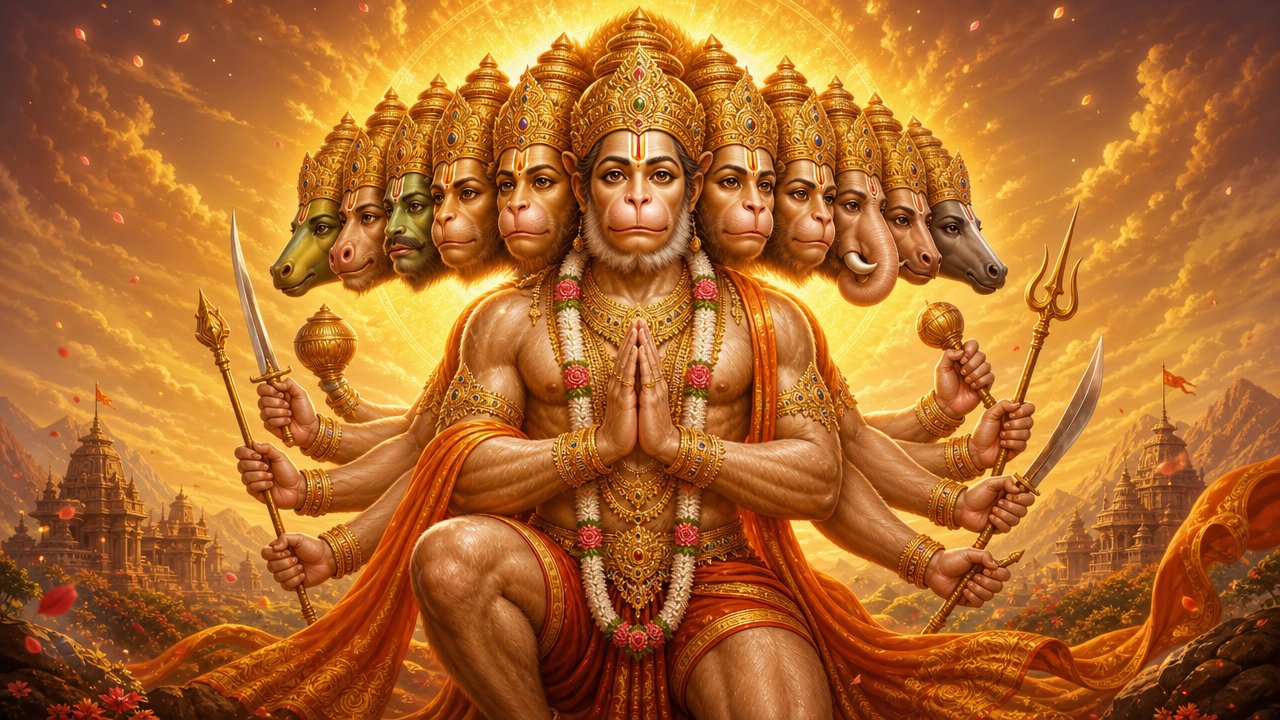
A kavach — literally “armor” — is a category of Sanskrit prayer built around a single idea: that naming a deity’s forms in sequence wraps the reciter in that deity’s protection, the way plates of armor cover a body limb by limb. The Ekādaśamukha Hanumat Kavacham, Lord Hanuman’s eleven-faced armor, is one of the more striking examples of the form, invoking a vision of Lord Hanuman rarely seen in ordinary temple iconography.
This presentation offers selected verses of the Kavacham rather than the complete text. The full prayer, in keeping with tradition, is meant to be learned directly from a teacher.
The Eleven-Faced Hanuman
The eleven-faced form comes from the Agastya Samhita tradition, where the sage Agastya is said to have taught it to his wife Lopamudra, having received it in turn through a line of transmission reaching back to Brahma. In this form, Lord Hanuman’s single face multiplies into eleven, each carrying the character of another deity or power: alongside his own monkey (kapi) face appear faces evoking Bhairava, Agni, Hayagriva (the horse-headed form), Varaha (the boar), a serpent form, Rudra, Narasimha (the lion-man), an elephant face, and a peaceful (saumya) countenance, among others. The effect is deliberate: rather than praying to Lord Hanuman as one deity among many, the eleven-faced form gathers many divine powers into Lord Hanuman himself, so that invoking him is understood to invoke all of them at once.
Why Only Selected Verses Are Shared
Texts of this kind are traditionally treated as living transmissions rather than public documents — learned face-to-face from a qualified teacher, who can also correct pronunciation and explain how the prayer is meant to be used. Publishing a kavach’s full verses outside that relationship is generally considered to work against the text’s own purpose. What is shared here, then, is the portion of the recitation appropriate to offer openly: enough to convey the devotion and the intention behind it, without the complete prayer.
Traditional Benefits
Within the tradition, recitation of this Kavacham is associated with protection from enemies and negative influences, and with blessings of peace, contentment, good health, fearlessness, freedom from obstacles, victory, and prosperity — the qualities named directly in this presentation’s own title: Shatru Nashak (destroyer of enmity) and Vijay Mantra (mantra of victory).
History & Devotion
Lord Hanuman’s kavachas exist in several traditions and lineages, each carrying its own emphasis — some centered on protection in battle, others on removing obstacles, others on granting fearlessness in daily life. What they share is the underlying logic of the kavach form itself: that a name spoken with devotion is not merely descriptive but protective, and that gathering enough names around oneself is itself a kind of shelter.
जय हनुमान 🚩 जय बजरंग बली 🚩 जय श्री राम 🙏
More from EkOmkaar Musicals
- केशव माधव गोपाल कृष्ण: दस अवतारों का भजन, सरल हिंदी में
- Keshav Madhav Gopal Krishna: The Ten Avatars, Now in Hindi
- Pralaya Payodhi Jale: The Song of Vishnu’s Ten Avatars, Explained Simply
- The Mahabharata Version of the Shiva Sahasranama | EkOmkaar Musicals
- Shiva Sahasranama: History and the Different Versions | EkOmkaar Musicals
- Shiva Sahasranamavali: Names and Meanings, One Line Each (Part 1) | EkOmkaar Musicals
- Main Paiya Hai | ਮੈਂ ਪਾਇਆ ਹੈ — Bulleh Shah Kafi | Lyrics & Meaning
- Ni Saiyon Main Gayi Gavachi | ਨੀ ਸਈਓ ਮੈਂ ਗਈ ਗਵਾਚੀ — Bulleh Shah Kafi | Lyrics & Meaning