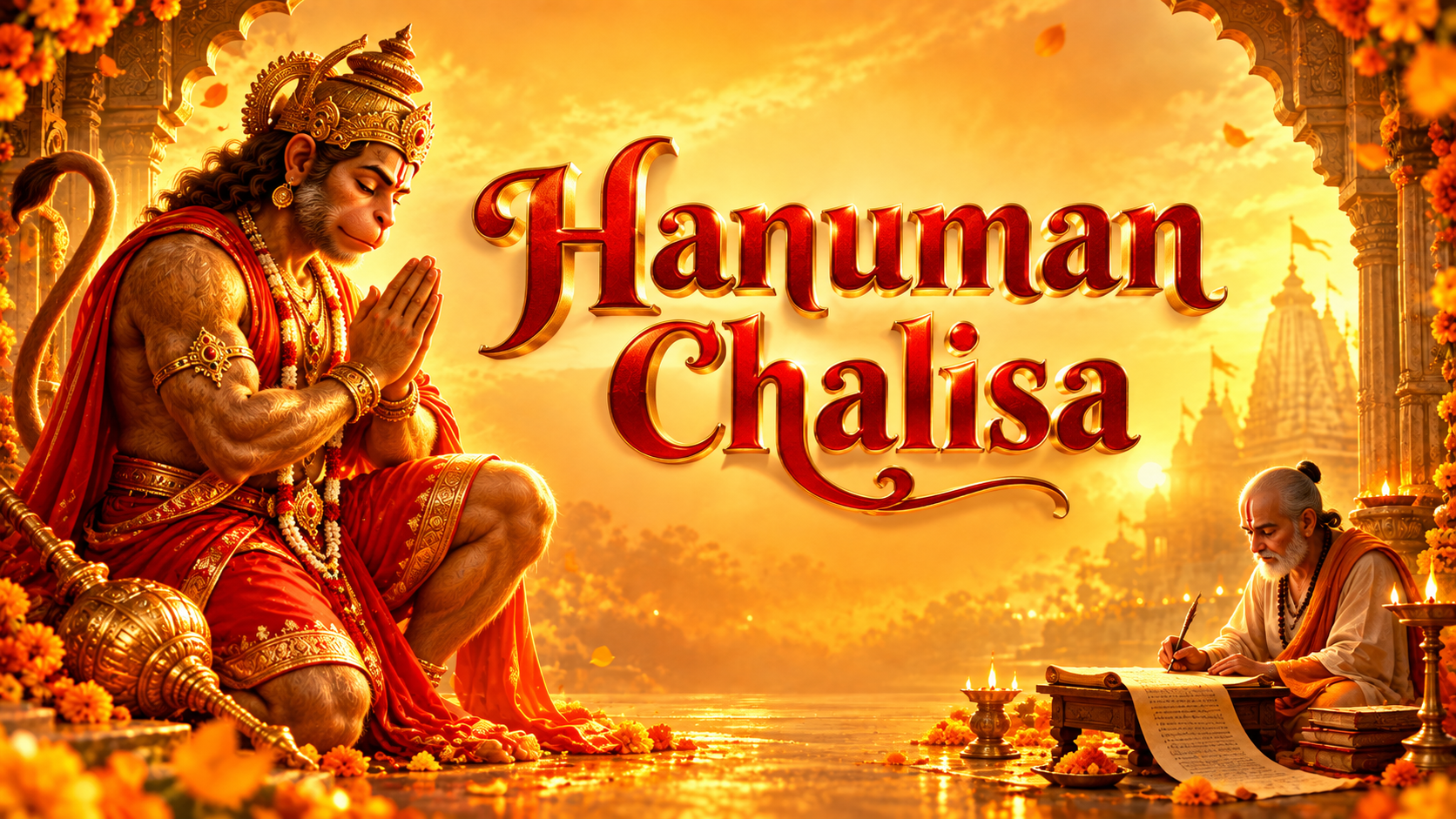
About This Hymn
जय हनुमान ज्ञान गुन सागर। For millions of families, the Hanuman Chalisa is the first long prayer a child ever learns by heart — learned not from a book, but by sitting beside a parent or grandparent and singing along. This EkOmkaar Musicals rendition honours exactly that: a father and son sing Goswami Tulsidas’s hymn together, with the lyrics on screen, so that any family can chant along and pass it to the next generation.
Chalisa means “forty,” and the hymn is named for its forty chaupais (four-part verses), framed by two dohas at the opening and one at the close.
Lyrics | हनुमान चालीसा
दोहा
श्रीगुरु चरन सरोज रज, निज मनु मुकुरु सुधारि।
बरनउँ रघुबर बिमल जसु, जो दायकु फल चारि॥
बुद्धिहीन तनु जानिके, सुमिरौं पवन-कुमार।
बल बुधि बिद्या देहु मोहिं, हरहु कलेस बिकार॥
चौपाई
जय हनुमान ज्ञान गुन सागर। जय कपीस तिहुँ लोक उजागर॥१॥
राम दूत अतुलित बल धामा। अंजनि-पुत्र पवनसुत नामा॥२॥
महाबीर बिक्रम बजरंगी। कुमति निवार सुमति के संगी॥३॥
कंचन बरन बिराज सुबेसा। कानन कुंडल कुंचित केसा॥४॥
हाथ बज्र औ ध्वजा बिराजै। काँधे मूँज जनेऊ साजै॥५॥
संकर सुवन केसरीनंदन। तेज प्रताप महा जग बंदन॥६॥
बिद्यावान गुनी अति चातुर। राम काज करिबे को आतुर॥७॥
प्रभु चरित्र सुनिबे को रसिया। राम लखन सीता मन बसिया॥८॥
सूक्ष्म रूप धरि सियहिं दिखावा। बिकट रूप धरि लंक जरावा॥९॥
भीम रूप धरि असुर सँहारे। रामचंद्र के काज सँवारे॥१०॥
लाय सजीवन लखन जियाये। श्रीरघुबीर हरषि उर लाये॥११॥
रघुपति कीन्ही बहुत बड़ाई। तुम मम प्रिय भरतहि सम भाई॥१२॥
सहस बदन तुम्हरो जस गावैं। अस कहि श्रीपति कंठ लगावैं॥१३॥
सनकादिक ब्रह्मादि मुनीसा। नारद सारद सहित अहीसा॥१४॥
जम कुबेर दिगपाल जहाँ ते। कबि कोबिद कहि सके कहाँ ते॥१५॥
तुम उपकार सुग्रीवहिं कीन्हा। राम मिलाय राज पद दीन्हा॥१६॥
तुम्हरो मंत्र बिभीषन माना। लंकेस्वर भए सब जग जाना॥१७॥
जुग सहस्र जोजन पर भानू। लील्यो ताहि मधुर फल जानू॥१८॥
प्रभु मुद्रिका मेलि मुख माहीं। जलधि लाँघि गये अचरज नाहीं॥१९॥
दुर्गम काज जगत के जेते। सुगम अनुग्रह तुम्हरे तेते॥२०॥
राम दुआरे तुम रखवारे। होत न आज्ञा बिनु पैसारे॥२१॥
सब सुख लहै तुम्हारी सरना। तुम रच्छक काहू को डर ना॥२२॥
आपन तेज सम्हारो आपै। तीनों लोक हाँक तें काँपै॥२३॥
भूत पिसाच निकट नहिं आवै। महाबीर जब नाम सुनावै॥२४॥
नासै रोग हरै सब पीरा। जपत निरंतर हनुमत बीरा॥२५॥
संकट तें हनुमान छुड़ावै। मन क्रम बचन ध्यान जो लावै॥२६॥
सब पर राम तपस्वी राजा। तिन के काज सकल तुम साजा॥२७॥
और मनोरथ जो कोई लावै। सोइ अमित जीवन फल पावै॥२८॥
चारों जुग परताप तुम्हारा। है परसिद्ध जगत उजियारा॥२९॥
साधु संत के तुम रखवारे। असुर निकंदन राम दुलारे॥३०॥
अष्ट सिद्धि नौ निधि के दाता। अस बर दीन जानकी माता॥३१॥
राम रसायन तुम्हरे पासा। सदा रहो रघुपति के दासा॥३२॥
तुम्हरे भजन राम को पावै। जनम जनम के दुख बिसरावै॥३३॥
अंत काल रघुबर पुर जाई। जहाँ जन्म हरि-भक्त कहाई॥३४॥
और देवता चित्त न धरई। हनुमत सेइ सर्ब सुख करई॥३५॥
संकट कटै मिटै सब पीरा। जो सुमिरै हनुमत बलबीरा॥३६॥
जै जै जै हनुमान गोसाईं। कृपा करहु गुरुदेव की नाईं॥३७॥
जो सत बार पाठ कर कोई। छूटहि बंदि महा सुख होई॥३८॥
जो यह पढ़ै हनुमान चालीसा। होय सिद्धि साखी गौरीसा॥३९॥
तुलसीदास सदा हरि चेरा। कीजै नाथ हृदय महँ डेरा॥४०॥
दोहा
पवनतनय संकट हरन, मंगल मूरति रूप।
राम लखन सीता सहित, हृदय बसहु सुर भूप॥
Meaning of the Hanuman Chalisa
The opening dohas. Tulsidas begins not with Lord Hanuman but with humility. “Cleansing the mirror of my mind with the dust of my Guru’s lotus feet, I describe the pure glory of Shri Ram, which grants the four fruits of life” — dharma, artha, kama and moksha. Then: “Knowing myself to be without wisdom, I remember the Son of the Wind. Give me strength, intelligence and knowledge, and remove my troubles and impurities.”
Who Lord Hanuman is (chaupais 1–8). Victory to Hanuman, ocean of wisdom and virtue, lord of the vanaras, light of the three worlds. He is Ram’s messenger, the home of matchless strength, son of Anjani, known as Pavanasut (son of the Wind). He is Mahavir, the great hero, with a body like a thunderbolt (Bajrangi); he drives away wrong thinking and keeps company with good thinking. His form shines golden, with earrings and curly hair; in his hands are the thunderbolt-mace and the flag, and the sacred thread of munja grass rests on his shoulder. Revered as an embodiment (amsha) of Lord Shankar and the son of Kesari, he is learned, virtuous and wise, always eager to do Ram’s work, and he delights in hearing the Lord’s story — Ram, Lakshman and Sita live in his heart.
His deeds in the Ramayana (9–20). He took a tiny form to appear before Devi Sita, and a fierce form to burn Lanka. He took a mighty form to destroy the demons and complete Shri Ram’s mission. He brought the Sanjivani herb and revived Lakshman, and Shri Ram embraced him with joy, saying, “You are as dear to me as my brother Bharat.” The serpent Shesha, the sages Sanaka and Brahma, Narada, Saraswati, Yama, Kubera and the guardians of the directions — none can fully describe his glory. He helped Sugriva meet Ram and regain his kingdom; Vibhishana followed his counsel and became king of Lanka. As a child he leapt at the sun, thinking it a sweet fruit. Holding the Lord’s ring in his mouth, he crossed the ocean — no wonder for him. Every difficult task in the world becomes easy by his grace.
His protection (21–30). He is the guardian at Ram’s door; no one enters without his permission. Whoever takes refuge in him finds every happiness and has nothing to fear. When he roars, the three worlds tremble; ghosts and evil spirits do not come near when his name is spoken. Continuous remembrance of Hanuman is said to remove suffering, and he frees from trouble everyone who holds him in thought, word and deed. He completed every task of Ram, the king-ascetic above all; his glory shines through all four yugas; he protects saints and sages and is the beloved of Ram.
His blessings and the closing (31–40). Mother Janaki (Sita) blessed him as the giver of the eight siddhis and nine nidhis. He holds the “elixir of Ram” and remains forever Ram’s servant. Through devotion to Hanuman one reaches Ram and forgets the sorrows of many lives. “Victory, victory, victory to Lord Hanuman — be gracious to me as a Guru is.” Whoever reads the Chalisa attains fulfilment, with Lord Shiva (Gaurisha) as witness. Tulsidas, forever the servant of Hari, asks only one thing: “O Lord, make your home in my heart.” The final doha asks the Son of the Wind, remover of troubles and embodiment of auspiciousness, to dwell in the heart together with Ram, Lakshman and Sita.
History & Devotion
The Hanuman Chalisa is traditionally attributed to Goswami Tulsidas (16th century), the poet-saint who also wrote the Ramcharitmanas. It is composed in Awadhi, the language of the Ayodhya region, which is why its words sound slightly different from modern Hindi — bidya for vidya, bijay for vijay, jas for yash. Its stories come from the Ramayana tradition: Hanuman’s meeting with Sita in the Ashoka grove, the burning of Lanka, and the bringing of the Sanjivani herb for Lakshman.
It is especially recited on Tuesdays (Mangalwar) and Saturdays (Shanivar), on Hanuman Jayanti, and at the start or end of the day. Many families recite it once daily; the Chalisa itself mentions reading it a hundred times (verse 38). Its simplicity is its strength: it needs no ritual and no special place, only a sincere heart — which is why it is the prayer so many parents give to their children.
Listen & Watch
▶️ Hanuman Chalisa – A Parent & Child Bhakti on YouTube
More for Lord Hanuman: Jai Bajrang Bali Hanuman, Ekadashamukha Hanumat Kavacham, and our Bedtime Mantra with Shri Ram & Hanuman.
जय हनुमान 🚩 जय बजरंग बली 🚩 जय श्री राम 🙏
More from EkOmkaar Musicals
- Mahalaxmi Mantra — ॐ श्री महालक्ष्म्यै नमः | Meaning & Benefits
- Ganesh Gayatri Mantra | गणेश गायत्री मंत्र — Lyrics & Meaning
- Shri Ganpati Sankatnashan Ganesha Stotram | संकटनाशन गणेश स्तोत्रम् — Lyrics & Meaning
- हे अंजनी के लाल — Jai Bajrang Bali Hanuman | Lyrics & Meaning
- Ekādaśamukha Hanumat Kavacham | Protection, Victory, Prosperity
- केशव माधव गोपाल कृष्ण: दस अवतारों का भजन, सरल हिंदी में
- Keshav Madhav Gopal Krishna: The Ten Avatars, Now in Hindi
- Pralaya Payodhi Jale: The Song of Vishnu’s Ten Avatars, Explained Simply
Leave a Reply