About This Song
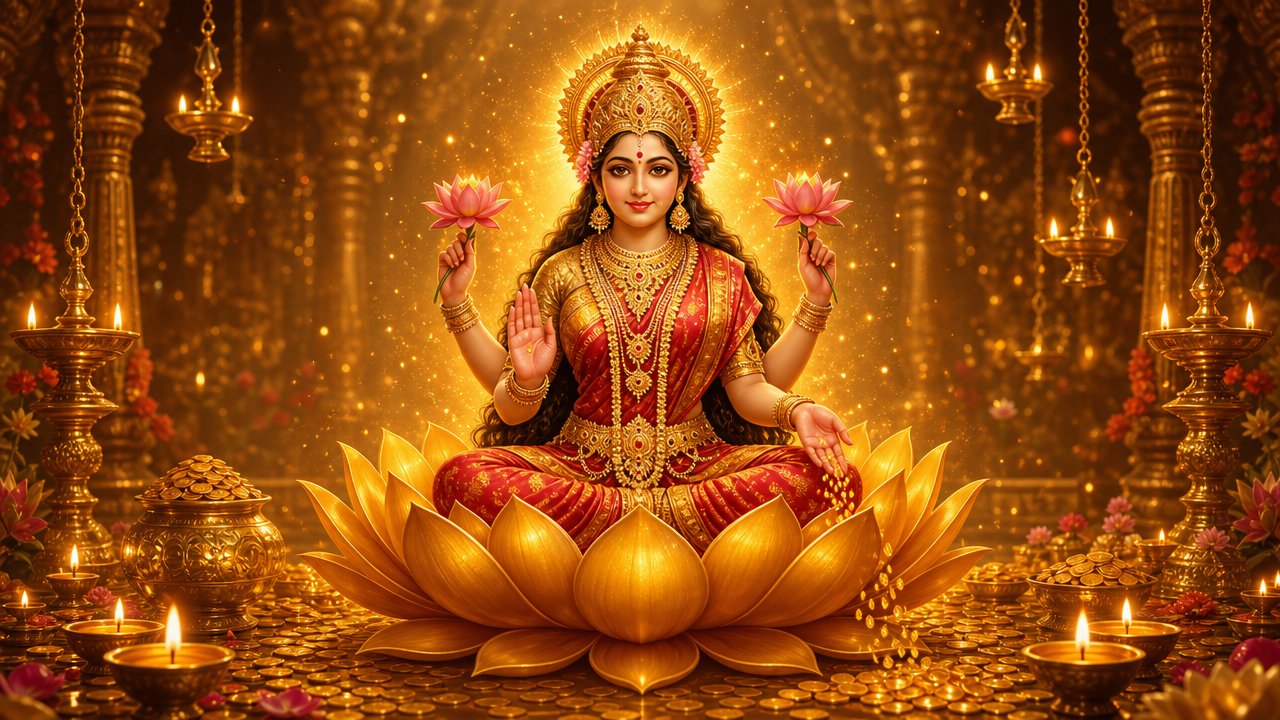
ॐ श्री महालक्ष्म्यै नमः। Nine syllables, repeated without hurry — this is the simplest way devotional practice knows to turn toward the Divine Mother. Where the Sahasranama traditions build their approach out of a thousand names, the Mahalakshmi Mantra takes the opposite path: one name, offered again and again, until repetition itself becomes the doorway.
The Mantra
ॐ श्री महालक्ष्म्यै नमः ॥
Om Shri Mahalakshmyai Namah
Meaning of the Mantra
Om is the primal sound, the vibration said to underlie all creation — the same one syllable this channel takes its own name from. Shri is the mark of auspiciousness and radiance that precedes the names of the Divine Feminine; it is also one of Goddess Lakshmi’s own names, so the mantra addresses her twice over before it has finished. Mahalakshmyai is “to Goddess Mahalakshmi” — the Great Goddess Lakshmi, the fullest form of the goddess of fortune, beyond her more specific forms as giver of grain, cattle, courage, or gold. Namah is the bow: I salute you, I set down whatever I am holding, in your presence.
Put simply: Salutations to the Great Goddess Lakshmi. But the plain translation undersells what the mantra is doing. It is not a request. It is an offering of attention, repeated until attention itself becomes steady.
Who Is Goddess Mahalakshmi?
Goddess Lakshmi is Lord Vishnu’s eternal consort, the goddess who rose from the churning of the cosmic ocean, and the presence invoked at Diwali when lamps are lit to welcome her into the home. But her domain reaches well past money. In her fullest form as Goddess Mahalakshmi, she governs shri in the widest sense — auspiciousness, nourishment, harmony, beauty, generosity, good fortune, and the kind of abundance that shows up as a settled, gracious household as much as a full treasury. In the Devi tradition she stands alongside Goddess Mahakali and Goddess Mahasaraswati as one of the three great forms of the Goddess — the one who sustains and beautifies what the other two create and illuminate.
Traditional Benefits of Chanting
Devotional repetition of this mantra is traditionally associated with inviting Goddess Mahalakshmi’s grace and blessings; cultivating prosperity and an attitude of abundance rather than scarcity; bringing auspiciousness into the home; encouraging peace, gratitude, and inner contentment; steadying concentration during prayer and meditation; setting a calm devotional tone for Lakshmi Puja; and deepening one’s bhakti and remembrance of the Divine Mother.
As with any mantra practice, the deeper aim is not the acquisition itself but the disposition it cultivates — gratitude, purity of intention, and the felt sense of already being held in abundance, out of which right action tends to follow.
ॐ श्री महालक्ष्म्यै नमः 🙏
More from EkOmkaar Musicals
- Ganesh Gayatri Mantra | गणेश गायत्री मंत्र — Lyrics & Meaning
- Shri Ganpati Sankatnashan Ganesha Stotram | संकटनाशन गणेश स्तोत्रम् — Lyrics & Meaning
- हे अंजनी के लाल — Jai Bajrang Bali Hanuman | Lyrics & Meaning
- Ekādaśamukha Hanumat Kavacham | Protection, Victory, Prosperity
- केशव माधव गोपाल कृष्ण: दस अवतारों का भजन, सरल हिंदी में
- Keshav Madhav Gopal Krishna: The Ten Avatars, Now in Hindi
- Pralaya Payodhi Jale: The Song of Vishnu’s Ten Avatars, Explained Simply
- The Mahabharata Version of the Shiva Sahasranama | EkOmkaar Musicals